

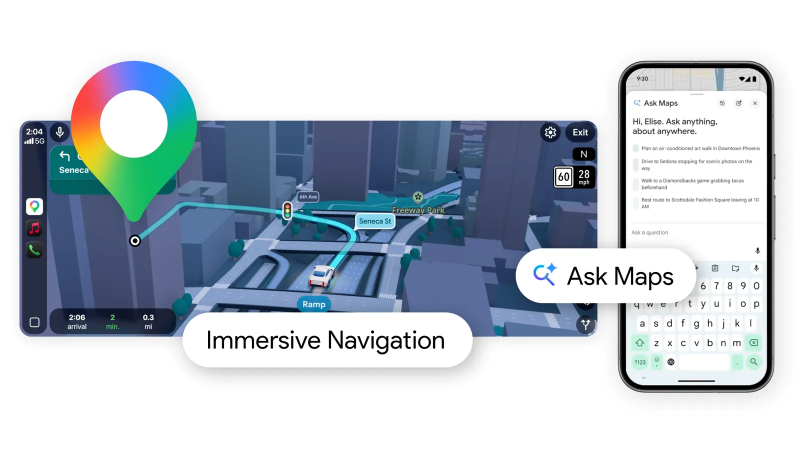
Google has announced a major update to Google Maps, introducing a new conversational feature called Ask Maps and a redesigned navigation experience powered by its advanced Gemini AI models. The update aims to make exploring places and driving more intuitive by transforming traditional map interactions into a conversational experience.
The new Ask Maps feature allows users to ask complex, real-world questions directly within the app. Instead of manually searching through reviews or listings, users can now ask questions such as where to find a charging spot without long queues or locate nearby sports facilities available at night. The feature analyses data from more than 300 million places globally, including insights from over 500 million contributors, to deliver personalised recommendations and a customised map view.
The tool also personalises results based on users’ past searches and saved places, helping them discover relevant options more quickly. Once users identify a location, the app enables them to take immediate action, such as booking reservations, saving destinations to lists, sharing locations with friends, or starting navigation.
According to Google, Ask Maps will begin rolling out to users in the United States and India on Android and iOS devices, with desktop availability expected in the near future.
Alongside the conversational search capability, Google is introducing Immersive Navigation, described as the most significant navigation upgrade to Maps in over a decade. The update features a vivid 3D view that reflects buildings, terrain, and road structures to help drivers better understand their surroundings. Critical road elements such as lanes, crosswalks, traffic lights, and stop signs are highlighted to assist with turns and lane changes.
The system also provides smarter route insights, including alerts about traffic disruptions, road construction, or alternative routes. Google says Maps processes more than five million traffic updates every second, supported by millions of driver contributions worldwide.
Immersive Navigation is currently rolling out across the United States and will gradually expand to compatible iOS and Android devices, as well as vehicles supporting CarPlay, Android Auto, and cars with Google built-in.