

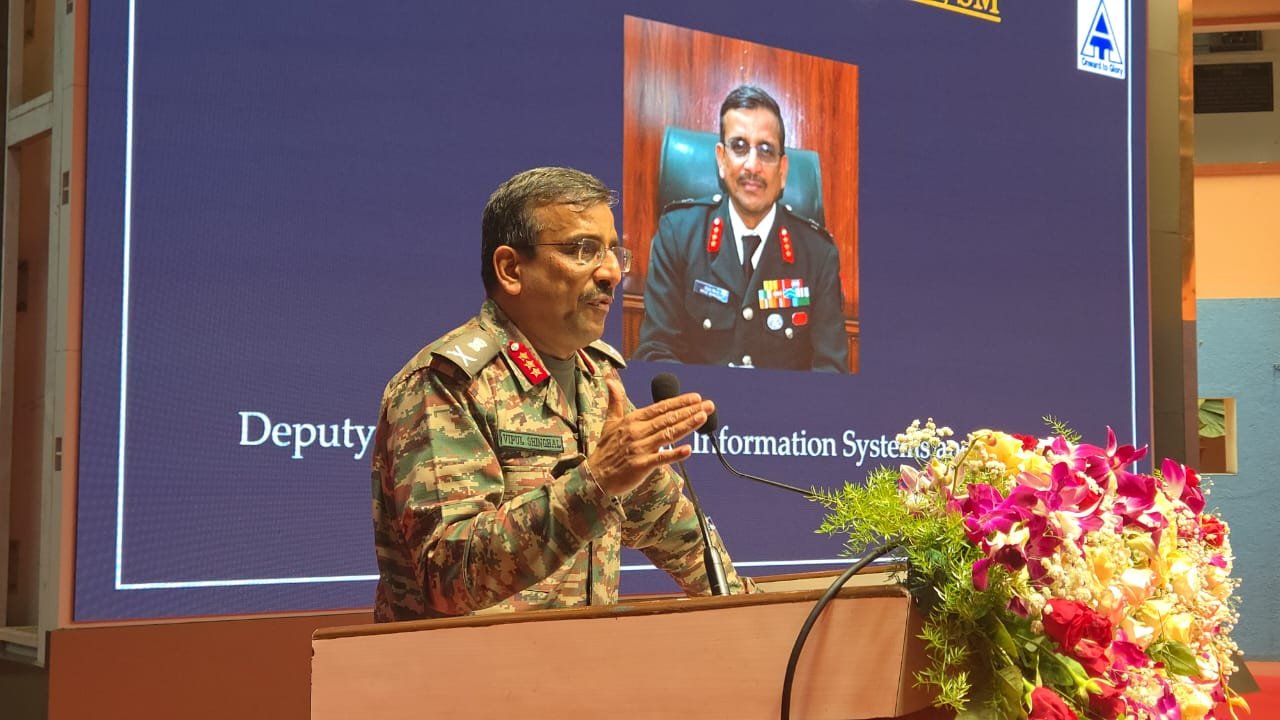
The Indian Army is focusing on sovereign artificial intelligence capabilities built around indigenous data, algorithms and computing infrastructure, while ensuring that AI-enabled and autonomous systems undergo rigorous testing and remain subject to human oversight, said Lieutenant General Vipul Shinghal, Deputy Chief of Army Staff (Information Systems and Technology), at the IEEE International Conference on Nexus of Digitization, Intelligence and Applications (ICNDIA 2026) at the Army Institute of Technology (AIT), Pune.
Speaking at the conference, Lt Gen Shinghal outlined the Army’s transition from manual information processing towards sensor-driven operations rooms supported by data fusion and AI-based decision-support systems. He said military commanders need to process information and make decisions at the “speed of relevance”, particularly as adversaries gain access to similar technological capabilities. He stressed that commanders using AI-assisted systems must understand how recommendations are generated rather than relying on opaque “black-box” solutions.
Lieutenant General Rajesh Pushkar, Army Commander, Southern Command, meanwhile, emphasised that the growing use of AI in defence must remain guided by human leadership, ethics and judgment. Delivering his address virtually due to urgent commitments, Lt Gen Pushkar described AI as a force multiplier for the Armed Forces and highlighted its potential in real-time data analytics, predictive maintenance, cyber defence, autonomous surveillance, precision operations, logistics optimisation and situational awareness.
“Technology alone does not win battles. While weapons evolve, victory ultimately belongs to those who combine technology with leadership, discipline, ethics and human judgment,” Lt Gen Pushkar said.
He cautioned against treating AI-enabled and autonomous systems as substitutes for human capabilities, stressing that human values must remain central to decision-making as defence organisations increasingly adopt intelligent technologies.
Lt Gen Pushkar also called for stronger collaboration between academia, startups, industry and defence organisations to develop AI solutions that are reliable, scalable and secure, while addressing operational requirements.
Lt Gen Shinghal underlined the importance of developing defence AI using sovereign data, indigenous algorithms and domestic computing infrastructure. The approach is intended to give the Armed Forces greater control over the technologies underpinning AI-enabled decision-making.
He also stressed that autonomous AI-enabled systems intended for military operations must undergo rigorous trials, validation and testing, similar to conventional weapon systems.
The Army is exploring AI-enabled cybersecurity, quantum technologies, federated data centres, edge computing and battlefield intelligence as areas for greater engagement with academia and industry.
Lt Gen Shinghal encouraged students and startups to participate in defence innovation programmes and develop solutions linked to operational requirements.
Lt Gen (Retd) Dr S.P. Kochhar, Director General, Cellular Operators Association of India, discussed the evolution of telecommunications from voice-centric networks towards intelligent, machine-oriented communication systems.
He highlighted standalone 5G, network slicing and edge computing as important capabilities for defence and industrial applications. AI-intensive workloads, he said, will require high-capacity networks, distributed computing resources and secure data processing.
Dr Kochhar said AI is currently being overlaid on 5G networks, while 6G is expected to be AI-native, with satellite communication integrated into its architecture. The convergence of AI and next-generation communications could enable applications including digital twins, immersive systems and automated decision-making.
Dr Makarand Joshi, Director, Research & Development Establishment (Engineers), DRDO, cautioned against treating AI as a software solution to every problem.
He said AI is rooted in mathematics, linear algebra and optimisation, making a strong understanding of these fundamentals important for students entering the field.
Drawing on R&DE(E)’s work, Dr Joshi highlighted applications including structural health monitoring of composite materials, landmine detection through sensor fusion, and the development of humanoid, biped and quadruped robotic systems.
He stressed that sophisticated algorithms require effective sensors and dependable hardware to address physical-world problems. Such challenges often require sustained research and cannot be addressed by AI models alone.
Prof Mukul Sutaone, Director, IIIT Allahabad, placed AI development within a broader framework of data, information, knowledge and wisdom.
He emphasised the importance of conscience, ethics and human responsibility in guiding technological development, describing AI as an assistant, companion and co-creator rather than a replacement for human intelligence and responsibility.
ICNDIA 2026 brought together defence leaders, researchers, industry specialists, faculty members and students to examine the convergence of digitisation, AI, intelligent systems and emerging communications technologies.
The discussions highlighted the importance of sovereign AI capabilities, secure infrastructure, explainability, rigorous testing, interdisciplinary research and closer collaboration between defence users and technology developers.