

Lockheed Martin has demonstrated an AI/ML-enabled sonar system capable of being rapidly retrained during missions to support anti-submarine warfare (ASW), in collaboration with the U.S. Navy during RIMPAC 2026 in Hawaii.
The system, SensorMAX, is designed to analyse subsurface acoustic data and help aircrews detect and identify potential underwater threats. The demonstration highlights how AI-enabled systems can provide continuously updated intelligence in complex maritime environments.
SensorMAX processes acoustic information collected through a network of sonobuoys, which function as underwater microphones, and provides a continuous stream of data to aircrews and ground operators. The system monitors spectral energy and assists personnel in identifying potentially relevant acoustic signatures.
A key capability demonstrated during the exercise was SensorMAX's over-the-air (OTA) model update capability. When operators identify a new target or acoustic signature, they can label the data, retrain the AI model and transmit a relatively small software update back to the aircraft.
According to Lockheed Martin, the process follows a closed-loop workflow of capture, label, retrain and deploy, allowing the system to adapt to newly identified underwater sounds during an operation. Retraining can be completed in less than five minutes per iteration.
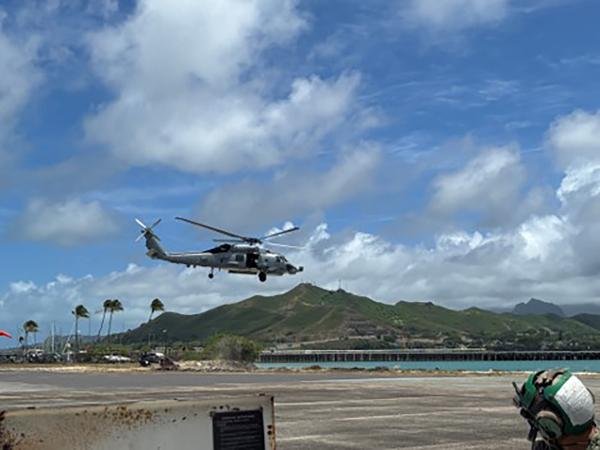
During RIMPAC, two MH-60R helicopters equipped with SensorMAX conducted ASW missions against an undersea threat off the coast of Hawaii. The helicopters deployed sonobuoys to collect acoustic data, which was processed by the AI system to support threat identification.
SensorMAX also enables aircrews to manage up to eight simultaneous sonobuoy surveillance feeds, which Lockheed Martin said doubles the capacity of legacy capabilities.
Following model retraining, ground operators transmitted updated AI models to the helicopters using an encrypted data link, enabling the aircraft to receive updated undersea intelligence during the mission.
The demonstration reflects a broader shift towards adaptive AI systems for defence, where models can be updated in response to new operational data rather than relying solely on models trained before deployment. Such capabilities could be particularly relevant in dynamic environments where acoustic signatures and threat conditions can vary.
Lockheed Martin said the RIMPAC demonstration also supports the U.S. Navy's broader vision for crew-uncrewed teaming, combining human operators, autonomous systems and AI-enabled capabilities to enhance maritime situational awareness.
“Today's battlespace requires the defence industry to accelerate capability delivery and seamlessly integrate commercial technology; at RIMPAC 2026, our mission-focused engineers demonstrated exactly how we are meeting that challenge,” said Devon Rodgers, Vice President and General Manager, Undersea Mission Systems, Lockheed Martin.
Rodgers added that the company is investing in the development of AI capabilities by combining commercial technology with its engineering expertise to support future naval missions.
The RIMPAC demonstration illustrates the potential of rapidly retrainable AI at the tactical edge, where the ability to learn from new sensor data and deploy model updates quickly could become an important component of next-generation defence systems.