

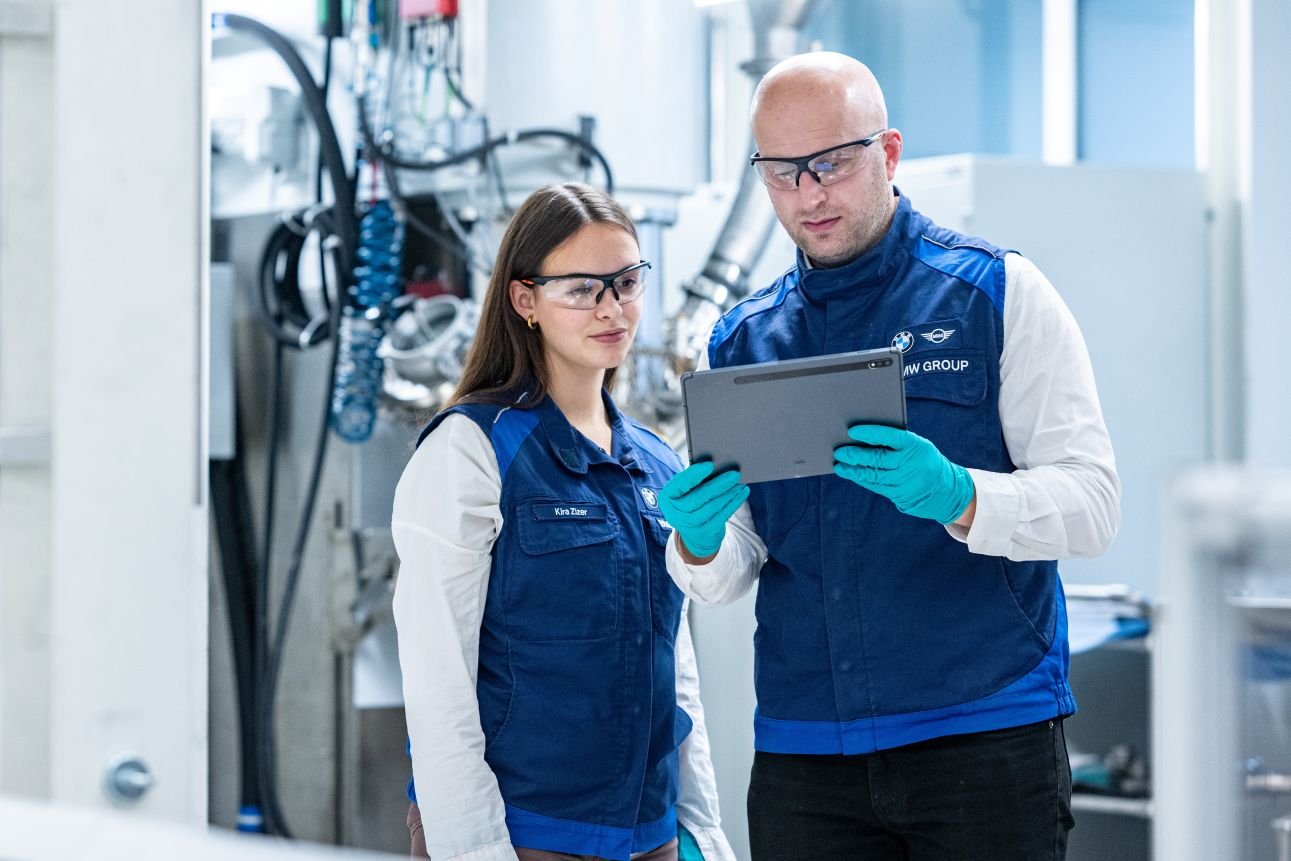
The BMW Group and the Croatian University of Zagreb’s Regional Centre of Excellence for Robotic Technology (CRTA) continue to advance joint research in battery cell production. The “Insight” research project will develop and implement practical AI models to optimise battery cell production at the BMW Group. The research project covers the entire battery cell value chain: from electrode production to end-of-line testing and in-house developed direct recycling.
At the Battery Cell Competence Centre (BCCC) in Munich, the BMW Group is developing battery cells for future generations of high-voltage batteries. As part of this process, numerous test series are conducted, which by their very nature require significant time and material investment. At the same time, these tests tie up manufacturing equipment and laboratory capacity. This is where the “Insight” research project comes in: Its artificial intelligence network uses existing test data, as well as real-time data from ongoing production, to accurately predict battery cell process parameters and performance data. As a result, the duration and number of test series can be significantly reduced, while maintaining or improving quality. In this way, the newly developed AI systems reduce the material and time required in individual process steps by more than 50 per cent.
The research project’s prediction models not only reduce the number of test series but also support the final approval of battery cells. Following initial charging at the end of production, the cells must be stored for a defined period at precisely specified temperatures before they can be installed in a battery housing. This phase, also referred to as the “quarantine”, requires corresponding storage capacity. However, the research project’s AI systems are able to conduct a full analysis of the battery cells in advance, potentially eliminating this process step in the future.
Since the project was launched in 2024, the BMW Group and the University of Zagreb have been developing joint solutions using artificial intelligence to improve battery cell production. To this end, doctoral candidates and students at the University of Zagreb are collating and structuring available production data and using it to create AI models that can identify specific patterns. These AI models then make predictions that further optimise production performance, quality and costs. “We are working on scaling the newly developed AI models from the prototype environment,” explains Christian Siedelhofer, head of Technology Development Lithium-Ion Battery Cells at the BMW Group. One option would be to enable cell manufacturers. “We are also examining to what extent these models are suitable for additional use cases within our production network.”