

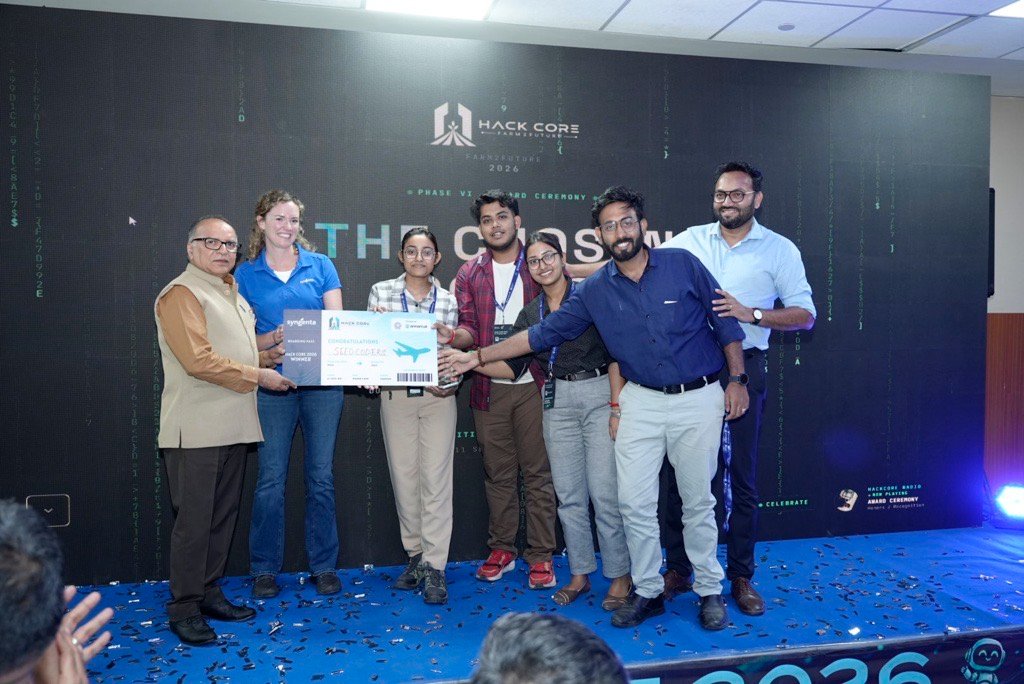
IIT Ropar’s ANNAM.AI and Syngenta Biologicals have jointly organised HACKCORE 2026, a three-day hackathon aimed at developing technology-driven solutions to help Indian farmers make informed decisions on the use of biological agricultural solutions.
The event brought together students, researchers and technology enthusiasts to develop artificial intelligence (AI)-based solutions addressing challenges across Indian agriculture. The initiative focused on applying AI, agricultural science and field data to improve the relevance and precision of recommendations available to farmers.
Team SeedCoders emerged as the winner with its AgroVani AI solution, which focuses on monetising crop residue and stubble while providing timely Syngenta product recommendations to farmers. The solution is supported by AgroSaathi, an AI chatbot designed to assist farmers.
As part of the prize, the four-member winning team will visit Syngenta Biologicals’ site in Atessa, Italy, to gain first-hand exposure to facilities and tools used in biologicals research.
Dr Pushpendra P. Singh, Project Director, ANNAM.AI, IIT Ropar, said the hackathon demonstrated the potential of bringing emerging technology talent closer to challenges faced by farmers. He added that skilling and capacity building are key priorities under the Digital Agriculture Mission and can contribute to building a climate-resilient agricultural sector.
The need for contextual AI-based decision-making is particularly relevant for biological solutions, whose effectiveness can vary depending on crop, soil, climate, disease pressure, geography and season.
Eladio Robles, Country Head & Managing Director, Syngenta India, said agricultural innovation creates value when it becomes useful at the farm level. He highlighted the potential of combining agricultural science, AI and field data to make biological solutions more precise, relevant and actionable for farmers.
HACKCORE 2026 highlights the growing role of AI and emerging technology in enabling data-driven decision-making and supporting more sustainable agricultural practices.