

Artificial intelligence is entering a new phase where systems are no longer limited to generating content or answering questions; they are increasingly capable of planning, reasoning, executing complex workflows, and collaborating across business functions with minimal human intervention. As enterprises move beyond isolated AI tools toward autonomous, agentic systems, the conversation is shifting from automation to orchestration, governance, and the evolving role of human expertise.
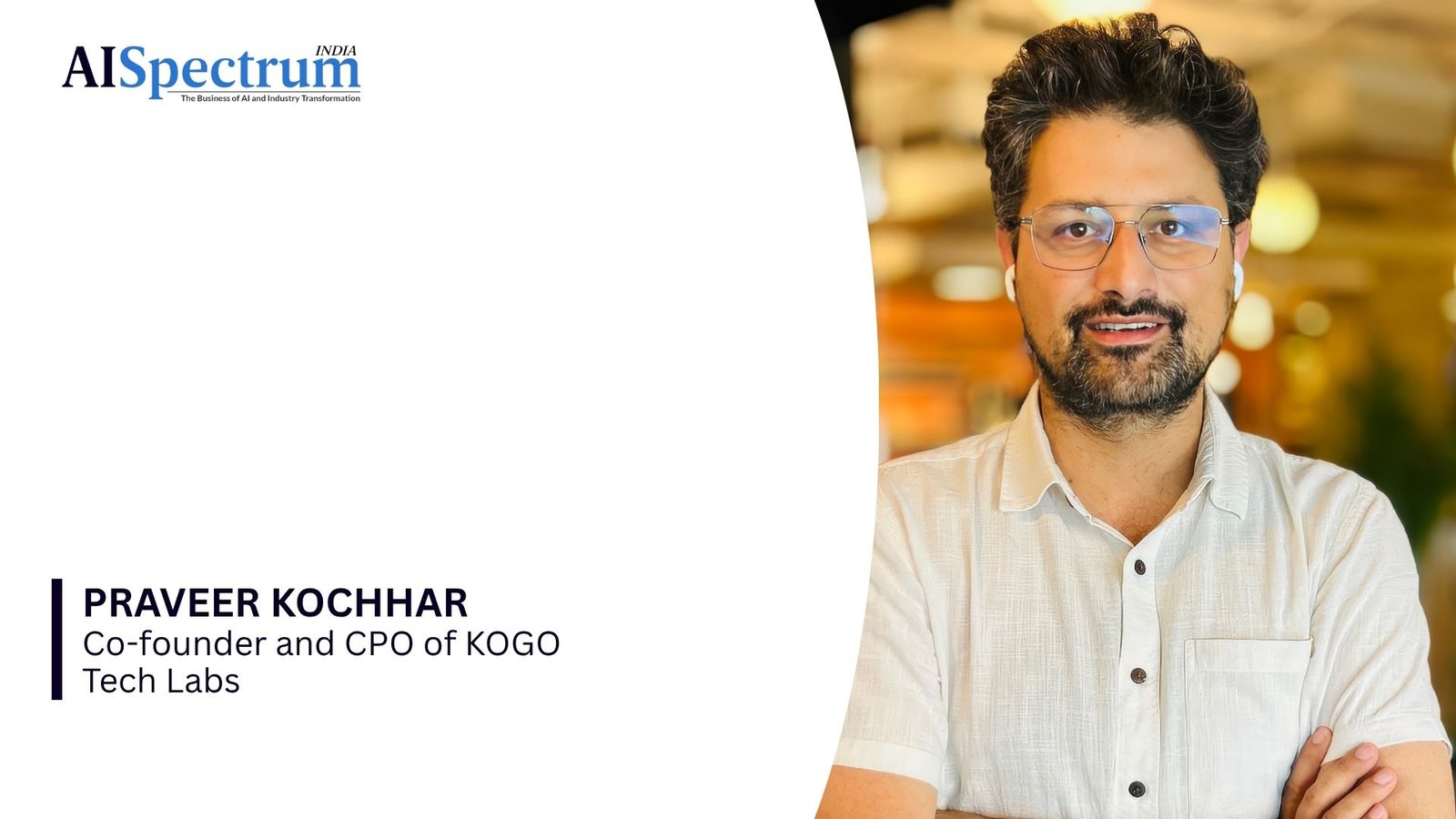
In this exclusive interview with AI Spectrum India, Praveer Kochhar, Chief Product Officer and Co-founder of KOGO AI, explains why the future of work is less about replacing people and more about elevating them from task execution to high-value decision-making. He shares how agentic AI is transforming enterprise operations through the "Agentic Loop" framework, why organisations must redesign roles around judgment and accountability, and how businesses can balance autonomy with governance. Kochhar also discusses the competitive risks of remaining at the task-automation stage, the skills knowledge workers will need in an AI-native economy, and why achieving a four-day work week is ultimately an engineering challenge enabled by intelligent, memory-driven AI systems.
You argue that AI agents can now execute 80–90 per cent of sophisticated workflows autonomously. In practical terms, what are the most important human responsibilities that remain, and how should organisations redesign roles around those responsibilities?
When AI agents collect data, analyse it, generate options and execute things, the human role concentrates around four things: judgment, values, taste and accountability. An agent can generate fifteen creative directions or run twenty configurations in minutes, but someone still has to decide which one earns its place in the market. That decision carries the brand’s reputation and the relationship with the customer, and no agent owns that responsibility.
Practically, organisations need to design roles around three functions. Architects design the workflow itself, deciding what data the agent pulls, which skills it chains together and where the quality gates sit. Conductors orchestrate multiple agents working in parallel across departments and manage the handoffs between them. Governors hold the override switch, read the explanations the agent produces and decide whether the output is ready to ship.
I run a 35-person technology team. Two years ago, most of that team wrote code line by line. Today, the same team designs pipelines, sets the guardrails and reviews what the agents produce. Their headcount has barely changed, but their leverage has grown enormously. The job title stays the same, but the actual work moves from doing to deciding.
Can you explain the Agentic Loop framework with a real-world enterprise example? How does it help leaders determine which decisions should remain human-led and which can be delegated entirely to AI agents?
The Agentic Loop starts from a simple observation. In the old model, an expert collected data, analysed it, generated insights, made a decision, acted on it and looped back. That cycle took days or weeks, with handoffs between teams at every stage, and by the time the action landed, the market had already moved.
In the agentic loop, an agent handles data collection, analysis and option generation, and increasingly execution as well. What stays with the human is the decision itself, the point where judgment, brand sense and risk appetite get applied. The loop compresses everything around that decision, so a person can make many more good decisions in a day instead of one slow decision in a week.
A good example comes from a project our partner Langoor ran for a car brand with dealerships across India. The brief called for region-specific ad campaigns across many languages and cultural contexts, the kind of work that would normally take an agency three weeks. A marketing agent built on Kogo OS gathered brand intelligence, product intelligence and consumer intelligence, built buyer archetypes from owner forums and reviews, wrote region-specific ad copy and produced visual direction, all within two hours. Because the original brief flagged range anxiety as a concern, the agent adjusted the call to action for that audience from “Book a Test Drive” to “Owner Reports” on its own, because it had retained that detail from the brief.
To decide what stays human and what gets delegated, leaders use an autonomy spectrum running from level zero to level four. If a marketing budget shifts by 5 per cent, the agent can act on its own. If it shifts by 20 per cent, it pauses and asks. For a creative refresh, a leader might let the agent generate freely, or insist on reviewing every word. The rules belong to the leader, not the agent, and that is what makes the framework useful. It turns "should AI do this" from a vague debate into a specific, written threshold a team can audit.
Many businesses are still experimenting with AI at the task level rather than the systems level. What are the biggest mistakes organisations make when implementing AI, and what competitive risks do they face by moving too slowly?
The most common mistake is treating AI as a faster search engine or a smarter autocomplete. Someone opens a chat window, types a prompt, gets an answer, copies it elsewhere and starts again tomorrow with no memory of what worked. That never compounds.
System-level use looks different. The agent holds the brand guidelines, the data, the past campaigns and the corrections in one place, and it gets sharper with every interaction. We see this play out concretely. Document operations that used to take hours drop by around 80 per cent. Departmental automation across marketing, sales, HR and operations runs roughly 300 per cent faster. Research and analysis work that took analysts days now runs about 400% faster. Those numbers come from a system that remembers.
The second mistake is over-engineering the instructions. Many teams treat the prompt as the most important part of the process and spend hours perfecting it. I would flip that. Trust the model to propose several options first, then apply judgment to choose between them. That single change produces better output faster than any amount of prompt tuning.
The competitive risk for organisations stuck at the task level is direct. Competitors build institutional memory and compounding intelligence every week, while laggards restart from zero every morning. A team using systems-level AI can run a cross-department workflow end to end with a full audit trail, while a task-level team still copies outputs between browser tabs. That gap does not stay small over a year. It becomes structural.
You describe the AI transition as a promotion rather than a replacement of human workers. What new skills, mindsets, and capabilities will be most valuable for knowledge workers over the next three to five years?
The skills that matter most are the ones agents cannot replicate: judgment, taste, narrative sense and the accumulated wisdom that comes from years in a domain. As agents take on more of the data work, analysis and drafting, the relative value of good judgment goes up, not down.
Three capabilities stand out in practice. Decision literacy is the ability to review several agent-generated options quickly and choose well, rather than producing one option slowly by hand. Orchestration is the ability to break a goal into a workflow, assign parts of it to different agents or sub-agents, and design the handoffs between them. Governance fluency means knowing how to set thresholds, read an agent's explanation for a decision and step in when something needs a human eye.
A mindset shift matters just as much as any single skill. People used to controlling every step of a task often try to control every word an agent produces, which slows everything down. A more useful mindset treats the agent as a capable colleague: brief it well, let it generate options, then apply taste. That is exactly the role I see for the people on my own team. They are not doing less valuable work. They are doing the part of the work that was always hardest to scale: thinking, choosing and standing behind the result.
As AI agents gain greater autonomy, how can organisations balance speed and productivity with governance, accountability, and risk management? What does "bounded autonomy" look like in practice?
Speed and governance are not opposites if an organisation designs for both from the start. We work from three principles. Bounded autonomy means the agent operates inside limits the organisation sets in advance, not limits it discovers after something goes wrong. Decision explainability means every significant action the agent takes comes with a readable reason, so a human can audit it later. Override by design means any action the agent initiates can be undone, redone or stopped, without exception.
In practice, this looks quite ordinary. I built a sales development agent that writes personalised outreach emails. It never sends them. It places every email in a draft folder, and I read each one before it goes out. I could automate a hundred thousand emails today, but the small human touch in each message matters more to the response rate than that scale would.
At an organisational level, this shows up as role-based and attribute-based access control, policy enforcement and shared memory across agents, so one team's guardrails apply consistently across the business. It also shows up in deployment choices. Enterprises in regulated sectors often need on-premises, private cloud or fully air-gapped deployment, so governance becomes a property of the infrastructure itself rather than a policy on paper. Compliance and audit then run continuously instead of being something a team assembles once a year.
The honest summary is this. Autonomy without these three things is exposure, not autonomy. With them in place, organisations can give agents real authority over real work, because every action stays bounded, explainable and reversible.
You have suggested that a four-day work week is fundamentally an engineering challenge. How close are we to achieving that reality, and what organisational changes are required to make it sustainable at scale?
When I say the four-day week is an engineering problem, I mean it literally. The total amount of useful work in a business does not need five days if the loop between insight and action keeps shrinking. A research task that took analysts days now runs in a few hours. A multi-market social intelligence dashboard that used to require a team and weeks of setup came together in about eight hours for one of our partners. Each time that loop compresses, the working week has room to compress with it.
How close are we? Closer than most people think, but it depends on the organisation doing the engineering work, not just buying a tool.
The biggest lever is institutional memory. If an agent has to relearn the brand, the data and past mistakes every single day, a team saves time on individual tasks but not on the week as a whole. Once that memory compounds, the savings stop being marginal and start changing how much total time a team needs.
The organisational changes required are structural more than technological. Teams need to move from task-based job descriptions to decision-based ones, so people get measured on the quality and speed of decisions rather than hours spent on tasks. Workflows need built-in quality gates so that faster does not mean sloppier. And leadership needs to actually claim the time AI frees up, rather than quietly filling it with more tasks. The four-day week will not arrive as an announcement. It will arrive gradually, team by team, as the loop gets short enough that the fifth day stops being necessary.