

The rapid expansion of AI infrastructure in India is signalling a shift from experimentation towards production-scale adoption, with enterprises increasingly investing in compute, networking, storage and cybersecurity to support sustained AI workloads. As inference becomes more prominent and AI applications move into everyday business operations, infrastructure readiness, data governance and security are emerging as critical components of enterprise AI strategies.
At the same time, the evolving AI ecosystem is reshaping the role of technology distributors, resellers and system integrators. Enterprises are increasingly looking for partners that can connect infrastructure, applications and security into integrated solutions, while addressing skills, deployment and operational challenges. India’s expanding data-centre capacity, growing regional markets and focus on data sovereignty are further creating opportunities for AI infrastructure providers and channel partners.
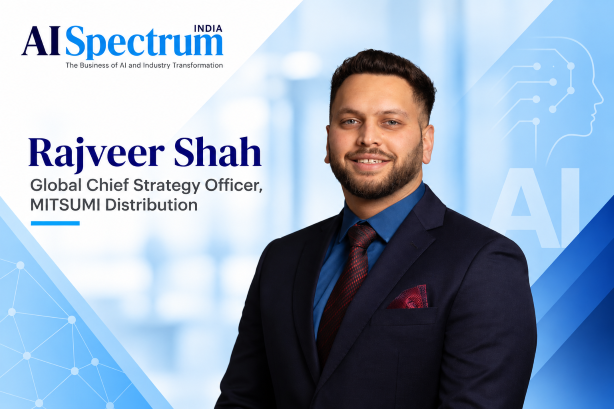
In this interview with AI Spectrum, Rajveer Shah, Global Chief Strategy Officer, MITSUMI Distribution, discusses the infrastructure trends expected to shape enterprise AI adoption in India over the next two to three years. He also explores the changing requirements across compute, networking, storage and cybersecurity, the evolving role of the technology channel, India’s sovereign AI and data-centre ambitions, and MITSUMI Distribution’s approach to enabling partners across AI, cloud, cybersecurity and enterprise IT.
India is seeing significant investments in AI infrastructure, including data centers, compute capacity, and networking. From MITSUMI Distribution’s perspective, what are the key infrastructure trends that will shape enterprise AI adoption in India over the next two to three years?
The investment is real, and the next phase is about turning capacity into usable business outcomes. Several trends will shape that.
The first is a shift in emphasis from experimentation to production. As enterprises deploy AI in everyday operations, inference- the work of running models at scale- becomes as important as training, and that changes what infrastructure customers need and where they need it.
The second is that networking is becoming a decisive layer. High-performance AI environments depend on fast, reliable connectivity, and many organisations will find the network is what limits them before compute does. Power, cooling and facility readiness will also influence how quickly capacity can be put to work.
The third is geographic spread. Demand will not stay confined to the large metros, and infrastructure and services will need to reach regional and smaller-city enterprises. Alongside this, hybrid architectures will become the norm, with workloads placed across on-premises, private and public environments depending on cost, performance and data requirements, and with security built in from the start rather than added later.
As enterprises move from AI experimentation to production deployments, how is the demand for AI-ready infrastructure changing across compute, networking, storage, and cybersecurity? What gaps do you see that technology providers and channel partners need to address?
In production, each layer has to carry more weight. On compute, enterprises are moving from buying capacity for pilots to sizing it for sustained workloads, with more attention to efficiency and cost. Networking needs higher throughput and lower latency to keep data moving. Storage is shifting towards handling large volumes of data quickly and reliably, because AI is only as good as the data feeding it. And cybersecurity has moved to the centre, since models, data and pipelines are now assets that need to be protected.
The gaps are mostly about integration and readiness. Many organisations are buying components without a clear view of how compute, network, storage and security fit together, and many lack the skills to design, deploy and operate that stack. Data readiness is often underestimated, and governance and security are frequently considered too late.
Technology providers and channel partners can address this by offering clearer reference designs, helping customers assess readiness before they invest, and supporting deployment and ongoing operations rather than stopping at the sale. The ability to bring the layers together is what will separate useful partners from transactional ones.
The technology distribution model is increasingly moving beyond hardware toward solution-led ecosystems. How is AI changing the role of distributors, resellers, and system integrators in helping enterprises select, deploy, and scale AI technologies?
AI is making every role in the channel more consultative. Enterprises face a crowded field of technologies and are looking for guidance on what fits their needs, what is ready for production, and how the pieces work together.
Resellers are moving from supplying products to advising on use cases and helping customers choose the right combination of technologies. System integrators carry more responsibility for bringing it all together: preparing data, integrating infrastructure and applications, deploying securely and keeping the environment running. Both are being asked to build skills that did not exist in their business a few years ago.
The distributor's role is to make that shift easier, and a big part of that is sharing use cases. Resellers often struggle to turn AI from an abstract idea into something a customer can picture in their own business. Distributors see what is working across vendors, partners and markets, so we can bring practical examples to resellers: where AI is delivering value, which technologies are being combined to get there, and what a deployment involves. That gives resellers a head start in customer conversations and helps them recommend with more confidence and less risk.
We do not build the technology; our value is in connecting vendors and partners effectively and helping the ecosystem work as a whole. As AI adoption scales, the ecosystems that share what they learn and coordinate well will move faster than those that do not.
MITSUMI entered the Indian market in January 2026. What opportunities do you see in India’s channel ecosystem, and what will be the company’s approach to enabling partners working across AI, cloud, cybersecurity, and enterprise IT?
India offers a rare combination of scale, momentum and diversity. Demand for AI, cloud and cybersecurity is growing across enterprises, government and a fast-expanding mid-market. The partner community is large and varied. It ranges from established national players to regional specialists serving smaller cities. There is a lot of potential for AI in particular, and the channel will be central to turning that potential into deployments.
Our approach is to build carefully. We are developing our portfolio to reflect the opportunity in AI and the technologies around it, and doing so in step with what partners and customers actually need rather than ahead of it. We start by listening, understanding where partners are today and where they want to go, and then build the portfolio and the support around that.
Our offices and warehouse network across India give us the reach to serve partners beyond the major metros. What partners can expect from us is a long-term commitment to their growth, with an emphasis on integrated solutions across AI, cloud, cybersecurity and enterprise IT rather than isolated products.
With growing discussions around sovereign AI and data sovereignty, how do you expect India’s data-center expansion and digital infrastructure investments to influence the deployment of AI workloads by enterprises and public-sector organizations?
Sovereignty is becoming a design requirement rather than a footnote. As AI moves into sensitive areas such as government services, financial services, healthcare and critical infrastructure, organisations are paying closer attention to where data resides, who can access it and under which jurisdiction it falls. India’s expanding data-centre capacity gives them credible options to keep those workloads in-country.
I expect this to influence deployment in three ways. Public-sector and regulated organisations will increasingly place sensitive AI workloads on India-hosted infrastructure. Enterprises will favour hybrid and multi-environment architectures, keeping regulated data local while using wider capabilities where it is appropriate. And regulation will increasingly shape architecture decisions from the outset, so compliance and security will need to be part of the design.
The infrastructure investment is only part of the answer. Sovereign AI also depends on skills, trusted integration partners and a mature ecosystem able to deploy and operate these environments. That is where the channel has an important role to play.
From your global experience across the Middle East and Africa, what lessons can international technology brands apply when entering and scaling in India, and how can value-added distribution and technical partner enablement accelerate their growth in the market?
The first lesson is to understand the market before trying to scale in it. Every region we operate in has taught us that a model which works in one place cannot simply be copied into another. India has its own buying behaviour, partner structures and expectations, and brands that take time to learn them tend to build stronger positions.
The second is that India demands both breadth and depth. Reaching the large metros is not enough. A great deal of demand sits in tier 3 and tier 4 cities, where customers and partners have different needs, different levels of technical capability and a need for closer support. Brands that can serve those markets well will have an advantage, and doing so requires a physical presence and a partner network that goes well beyond the major cities.
This is where value-added distribution helps. A distributor with local reach, partner relationships and logistics can give a brand access to markets it would take years to reach alone, and can help partners build the technical confidence to sell and support new technologies. For international brands, that combination of reach and enablement is often the fastest way to build a lasting presence in India.