

As artificial intelligence and autonomous systems continue to transform the future of modern warfare, it is strengthening its long-term commitment to India through localisation, indigenous manufacturing and advanced battlefield autonomy solutions. The company’s decision to establish a wholly owned subsidiary in India marks another significant milestone in its strategic expansion plans, positioning the country as a key hub for innovation, production and talent development in the defence AI ecosystem.
With initiatives spanning the indigenous production of the V-BAT unmanned aircraft system in partnership with JSW Defence, the expansion of Hivemind autonomous software operations, and plans to build AI engineering capabilities in India, Shield AI is aligning closely with the country’s vision for self-reliance in next-generation defence technologies.
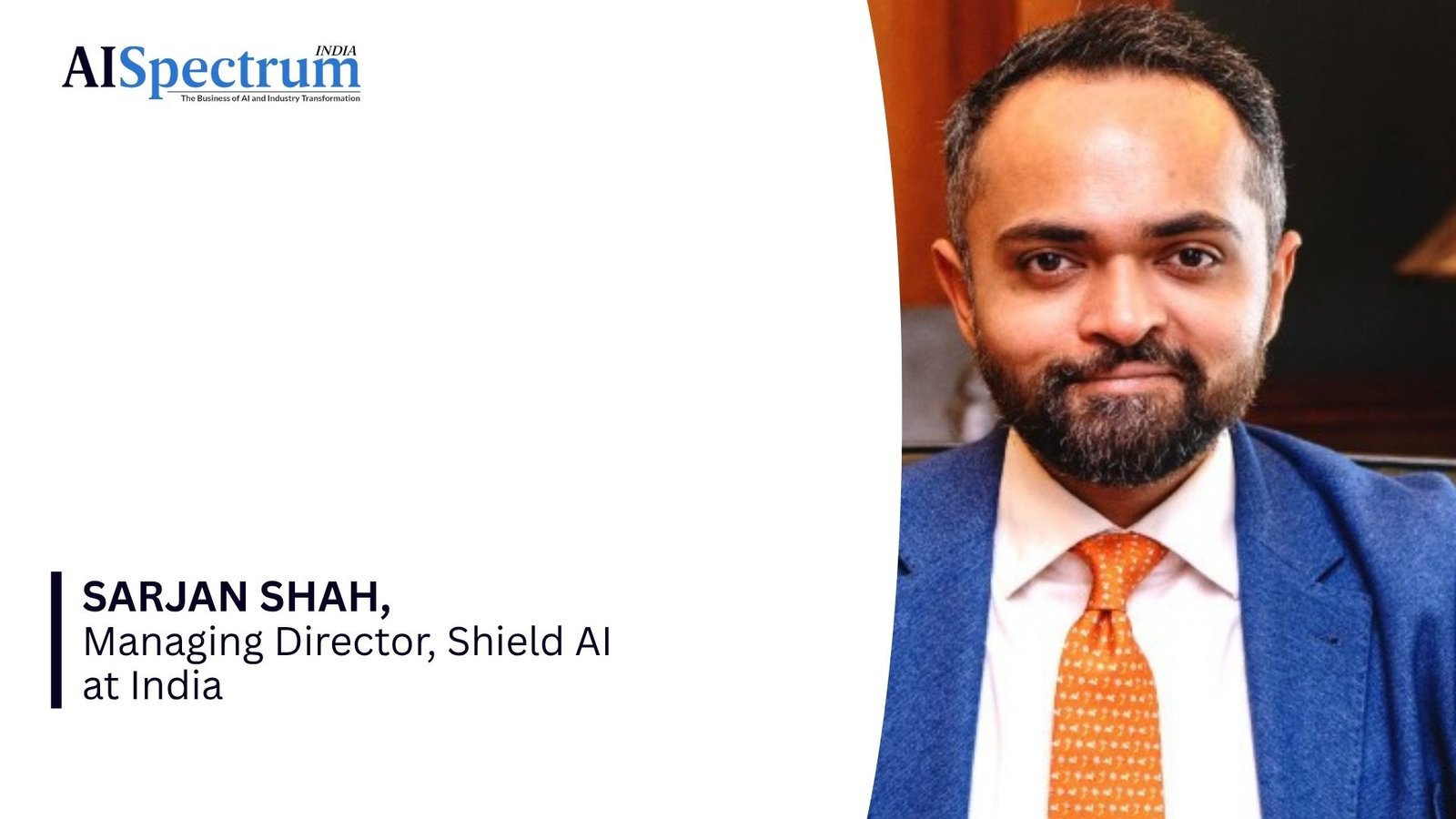
In this interview with AI Spectrum, Sarjan Shah, Managing Director, Shield AI, India, discusses the company’s India growth strategy, the role of AI-powered autonomy in contested battlefield environments, the importance of localisation and co-development, and how India could play a larger role in Shield AI’s future roadmap for advanced autonomous platforms such as X-BAT.
What strategic factors influenced Shield AI’s decision to establish a wholly owned subsidiary in India, and how does this align with your global growth strategy?
Shield AI made the decision to make India a top international priority in 2022. As a result, India is the only country in the world where we have pre-emptively executed a comprehensive transfer of technology to establish a fully indigenous production line and supply chain for our advanced Group 3 ISR UAS, V-BAT. That agreement with one of India’s national champions, the JSW Group, was executed in October 2024 and we are making steady progress on the actual indigenisation and infrastructure build-out project.
We received all necessary U.S. export control authorisations to transfer V-BAT technology by March 2025 and have moved with agility to prioritise any requirements of the Indian Armed Forces after Operation Sindoor, leading to an Emergency Procurement contract for both autonomous V-BATs and Hivemind software, signed in December 2025.
The office opening in New Delhi is simply a further milestone in our long-term investment in India, established to support continued presence and engagement with our customers as we continue to engage in strategic discussions.
Our planned Bengaluru office opening for later this year is designed to attract and retain the best talent in India for our Hivemind operations.
How do you see Shield AI contributing to India’s ambitions in autonomous defence systems and AI-driven military innovation?
Our business consists, globally, of two divisions – aircraft and autonomy. In India, we have already established a firm foundation for our mature Group 3 ISR platform, the V-BAT. We look forward to JSW manufacturing V-BATs in India at scale.
In parallel, we are continuing to scale our Hivemind operations in-country to bring autonomous solutions across unmanned systems that are currently inducted, being inducted or under development by Indian PSU or private industry players. We hope to provide sovereign, secure, safe battlefield autonomy solutions to India’s warfighters at scale.
X-BAT is the world’s first autonomous VTOL combat aircraft – boasting fighter-class propulsion, a full payload suite, and VTOL capabilities. This is an extremely advanced system currently under development in the United States. Given our deep and strengthening relationship with India, X-BAT may eventually feature in our planning for the country.
How will the integration of Hivemind with the V-BAT platform enhance operational effectiveness in contested and beyond-visual-range environments?
In modern warfare, GPS and communications are the first things to go. Hivemind allows the V-BAT to operate entirely independently of these links, using AI-powered perception and cognition to complete missions in "denied" environments. This integration enables beyond-visual-range operations where the drone can identify and track targets autonomously, providing a resilient, expeditionary intelligence capability that legacy systems cannot match.
What role will Shield AI India play in developing indigenous AI and autonomy expertise within the country?
Shield AI India is our commitment to growing a pipeline of Indian engineers and developers. Through the licensing of our Hivemind Software Development Kit (SDK), we are empowering local partners and the Indian Ministry of Defence to develop, test, and deploy their own mission-specific autonomy applications. This ensures that the expertise remains in-country, allowing India to evolve its autonomous capabilities on its own terms.
How important is localisation and co-development, such as your partnership with JSW Defence Pvt. Ltd., in shaping the future of defence AI deployments in India?
Since our original decision in 2022, we have built a multi-layered and multi-vector India plan. This consists of establishing for V-BAT, global production and MRO operations, flight and operator training operations, global spares and replacements supply; for Hivemind, global autonomy development / professional services teams, to export AI pilots, and for Shield AI’s global corporate services, a support hub for the entire Asia-Pacific region
This multi-layered approach means that we are deeply invested in and localised across our product lines and are fully present in-country to be responsive and agile to customer requirements.
How do you envision India’s role in Shield AI’s global innovation roadmap, particularly regarding next-generation platforms like the X-BAT?
Given our deepening relationship with India, X-BAT may eventually be included in our planning for the country.