

Artificial intelligence, computer vision and geospatial technologies are increasingly transforming agriculture by enabling more granular, data-driven insights from the field. As farmers and agricultural stakeholders contend with climate variability, fragmented data and the need for greater supply-chain visibility, technologies that can convert field-level observations into actionable intelligence are gaining importance.
Wingsure COFFEA brings together AI, computer vision, augmented-reality-assisted data capture, multilingual voice interaction and geospatial analytics to build a continuously evolving digital record of coffee farms. The platform is designed to combine ground-level evidence with satellite, drone and historical farm data, supporting applications ranging from crop and yield intelligence to sustainability, sourcing, insurance and financial risk assessment.
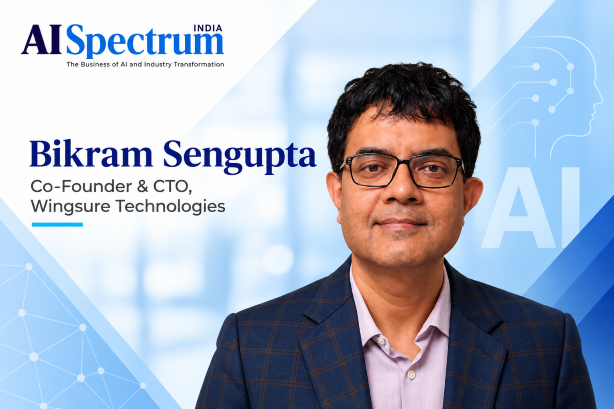
In this interview with AI Spectrum, Bikram Sengupta, Co-Founder & CTO, Wingsure Technologies, discusses how the company’s technology stack converts field observations into evidence-grounded intelligence, while addressing challenges such as limited connectivity, multilingual interactions, data quality and the variability of smallholder farming environments. He also outlines how longitudinal farm intelligence could reshape decision-making across the agricultural value chain and how advances in AI, computer vision and geospatial intelligence could support Wingsure’s expansion beyond coffee and across geographies.
Wingsure COFFEA combines AI, computer vision, augmented-reality capture, multilingual voice, and geospatial analytics to build farm intelligence. Could you explain how these technologies work together to convert field-level observations into actionable insights for coffee stakeholders?
The simplest way to think about these technologies in the context of Wingsure COFFEA is as a chain that connects what happens on the farm to what a stakeholder can act on.
It starts with the farmer or field team. Guided smartphone capture, augmented-reality assistance and multilingual voice make it easy to collect the right observations in a consistent way, even in environments where digital literacy or connectivity may be limited.
Computer vision then helps interpret what is visible in photographs and videos—for example, characteristics of plants, leaves, fruits or other field conditions, as well as various farm practices. Geospatial analytics add another dimension, bringing in satellite, drone and other spatial data to understand those observations in the broader context of the farm and its surroundings.
AI and machine learning bring these different signals together with the farm's history and relevant agronomic knowledge. This is where individual observations start becoming intelligence: a change in crop condition, evidence of a particular practice, a production-related signal, or an indication that a particular area may need attention. That evidence-grounded intelligence can then support decisions across sourcing, sustainability, production, risk, insurance and finance.
The platform captures evidence that is geotagged, timestamped, and linked to satellite and drone data. How does Wingsure ensure the accuracy, authenticity, and traceability of the data used by its AI systems?
For us, trustworthy intelligence starts with trustworthy evidence.
The Wingsure platform is designed so that field observations carry the context to understand where and when they were captured and how they relate to the farm. Evidence can then be linked to other observations and to satellite or drone data, giving us a consistent chain of provenance rather than a collection of disconnected images or records.
We also use appropriate validation and cross-checking to help identify inconsistencies before information is used for decision-making. These are built into the platform itself, and based on the application, may include feedback from users. The objective is to identify errors or inconsistencies before they propagate into downstream analysis.
Equally important, the intelligence remains connected to the evidence behind it. That gives stakeholders greater confidence in both the information they are receiving and where it came from.
Agricultural environments are highly variable, particularly across smallholder farms. How does Wingsure’s AI adapt to differences in crops, farm practices, geographies, languages, and data quality when generating intelligence?
Agriculture is inherently local. A coffee farm in Colombia cannot simply be treated the same way as a farm in another crop, climate or geography.
Wingsure combines a common technology foundation with models, workflows and knowledge that can be adapted to the specific crop, use case and operating context. Rather than looking at an observation in isolation, we consider the broader context in which it was captured. For example, crop images can reveal damage, but the loss in yield would need to be assessed using the phenological growth stage and agronomic knowledge.
The same principle applies to the farmer experience. Language, terminology and guidance in the interaction layer can be adapted locally while the underlying platform remains consistent.
Data quality is another part of the equation. Guided capture helps create more consistent inputs while validation checks or user feedback loops allow the intelligence to become better suited to the environments in which it is being used.
All of these allow us to scale without assuming that every farm or every farmer will look or behave the same.
Wingsure COFFEA is designed to work offline and support multilingual voice-based interactions. What technical challenges did the team encounter in developing AI capabilities for areas with limited connectivity and diverse linguistic requirements?
One of the fundamental challenges in building the Wingsure platform for farmers is deciding what needs to happen on the device, what can be deferred until connectivity is available, and how the two work together seamlessly.
On the device, we need enough sensing and intelligence to engage and guide the farmer in the field, even when there is no connectivity. Once connectivity is available, more computationally intensive analysis can happen in the cloud, combining the captured evidence with other data sources and models to enrich the intelligence we derive from it.
There is also a less visible but important engineering challenge around data itself. The application needs to make intelligent use of device storage without making the farmer think about managing images, videos or maps. Synchronization has to work reliably and seamlessly in the background to ensure continuity of the farm record.
Language is equally important. Voice and multilingual interaction are not simply about translating an application. They are about making the technology feel natural and understandable in the farmer's own context.
Ultimately, the technological sophistication should be largely invisible to the farmer. The experience itself must remain simple and memorable.
The platform aims to create a continuously developing digital record of each farm that can be reused for sustainability, sourcing, production, insurance, and risk assessment. How could this longitudinal farm intelligence change decision-making across the agricultural value chain?
The biggest shift is from looking at a farm as a snapshot to understanding it as a trajectory. A single observation tells you what was happening at one point in time. A longitudinal record lets you understand how conditions are changing, what interventions have taken place, and what the farm has demonstrated over time.
The same evolving intelligence can be reused by different stakeholders rather than each creating a separate snapshot of the farm. Take sourcing and supply, for example. A supply function might traditionally rely on a one-time regional yield estimate. With Wingsure COFFEA, verified ground observations collected through the season can be combined with other data to create continuously updated yield intelligence, useful to the farmer planning harvest, the agronomist recommending an intervention, the sustainability expert assessing the impact of regenerative agriculture, as well as the buyer planning procurement.
The same principle applies to risk and finance. An insurer can move from assessing a farm primarily at the time of a claim to continuously assessing its risk through the season and across seasons. Similarly, financial institutions can use a verified farm record built over several seasons to assess credit risk from a more grounded understanding of the farm. The farmers demonstrating responsible farming practices over time may then benefit from more personalized financial products and services.
The longitudinal record therefore becomes more than a record: it becomes an asset whose value can appreciate as credible evidence accumulates.
Looking ahead, how does Wingsure plan to scale Wingsure COFFEA beyond coffee and across geographies, and what role will advances in AI, computer vision, and geospatial intelligence play in the company’s broader agricultural technology roadmap?
Wingsure COFFEA is deeply focused on coffee, but it is built on a broader Wingsure technology foundation developed for agriculture. We already have capabilities across several other crops and use cases.
As AI, computer vision and geospatial technologies continue to improve, they will allow us to understand farms more accurately and with less burden on the farmer. Our role is to bring those capabilities together in a way that remains practical in real agricultural environments.
The larger opportunity extends well beyond coffee. Across global agriculture, major decisions about supply, sustainability, risk and investment ultimately depend on millions of individual farms that remain only partially visible. Bringing better intelligence from those farms into the system can transform how risk is priced, capital is allocated and supply is planned.