

There are two versions of what happened in New Delhi on Wednesday.
In the first version, a large American technology company made an operational mistake, a video by the Prime Minister of India was briefly unavailable, the company apologised, and a diplomatic irritant was cleared away. That is the version most global wire copy carried, and it is not wrong.
In the second version, Meta walked into Rail Bhawan and conceded, in front of the Union Minister for Electronics and Information Technology, that its systems had taken money to amplify content to selected audiences, and that some of that amplified content was illegal. If that concession stands, it does not just settle a row about one post. It quietly removes the floor from under the legal position that has protected every large platform operating in India for the last twenty five years.
The first version is a news story. The second is a structural break, and it is the one this publication is interested in.
What actually happened, in sequence
The chain of events is worth laying out plainly, because the sequencing explains the leverage.
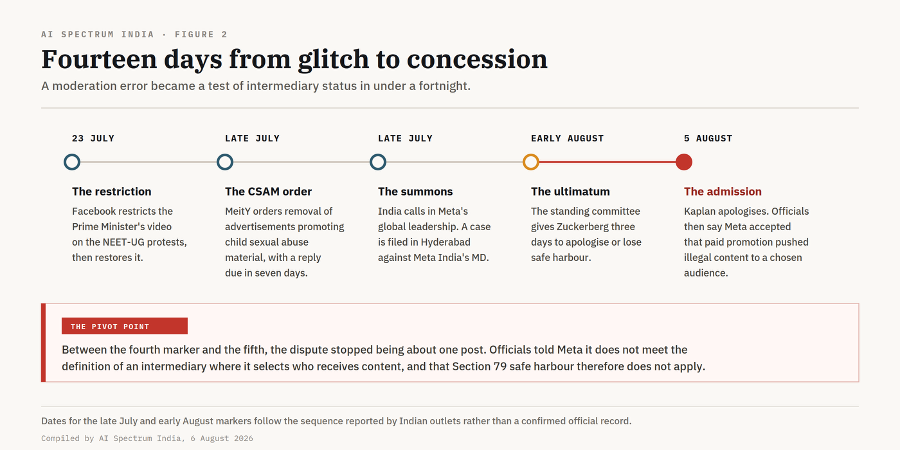
On 23 July, the Prime Minister posted a video addressing the student agitation over the NEET-UG 2026 examination irregularities, first on Instagram and then on Facebook. The video marked his first direct address to the protesting students during a 36 day agitation. Facebook restricted access to it. Meta later said an operational error had caused the block, and the video was restored, but India summoned Meta’s global leadership after the incident. The parliamentary standing committee took note of the fact that the post was reportedly unavailable for several hours in the early morning.
Around the same window, a second and far more serious line of pressure was building. In July, the Indian government had ordered Meta to remove advertisements and content promoting child sexual abuse material on Instagram, and sought an explanation within seven days on how advertisements containing such material were allowed on the platform at all. The National Commission for Protection of Child Rights and the National Human Rights Commission have both initiated inquiries.
Then came the ultimatum. The parliamentary standing committee chaired by Nishikant Dubey gave Zuckerberg a three day deadline to apologise, with the loss of safe harbour protection held out as the consequence of refusal. The committee’s written position to the IT and Home ministries was that deleting the Prime Minister’s video was not the act of an intermediary but the act of a publisher.
Meta arrived on Wednesday. Chief Global Affairs Officer Joel Kaplan said afterwards that he had apologised to the minister on behalf of Meta for the error restricting the post. The delegation met Minister Ashwini Vaishnaw and IT Secretary S. Krishnan. Separately, and reported through government sources rather than a company release, Zuckerberg himself apologised for the presence of child sexual abuse material, for deepfake content, and for operational lapses.
And then the sentence that matters. Meta accepted, according to government sources, that a large volume of illegal content had been promoted, and that paid promotion had been carried out for a specific audience. Officials say the company acknowledged it had accepted payments to boost certain categories of content, and that this had resulted in illegal content being amplified to particular audiences.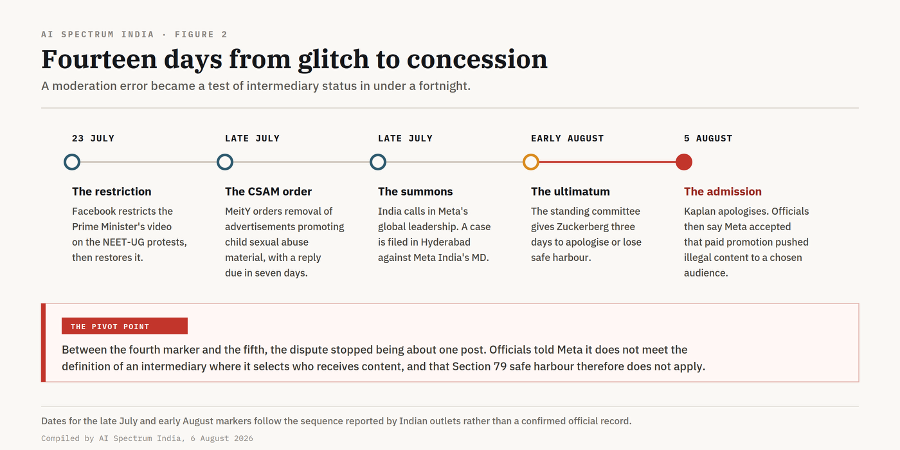
Why the second apology is worth more than the first
Three separate apologies were issued this week, and they are not equivalent.
The apology for restricting the Prime Minister’s post is the cheapest of the three. It costs Meta nothing beyond embarrassment, because it fits the narrative the company most wants to tell about itself: a system so large that it occasionally misfires, corrected by humans as soon as they notice. Nobody is fined for a glitch.
The apology for CSAM and deepfakes is expensive but survivable. It is an admission of failed enforcement, and failed enforcement is a resourcing problem. The remedy is more classifiers, more reviewers, faster escalation, and a compliance narrative that regulators have seen a hundred times.
The third admission is different in kind, and Meta’s lawyers will know it.
Failing to catch bad content is negligence. Being paid to distribute it, and directing it at a chosen audience, is participation.
That distinction is the entire architecture of Indian platform law. Government representatives told Meta directly that a company is not covered by the definition of an intermediary where it selects who receives content, and that safe harbour under the Information Technology Act is therefore not applicable. Officials at the meeting made the point in the sharpest available form: Meta no longer fits the legal definition of a passive intermediary under Indian law.
Read that as a business risk rather than a legal abstraction. Losing Section 79 protection exposes a platform to direct civil liability, criminal scrutiny and considerably more aggressive oversight. For a large intermediary, the loss of safe harbour is the real penalty behind India’s rules, far more than any fixed monetary fine.
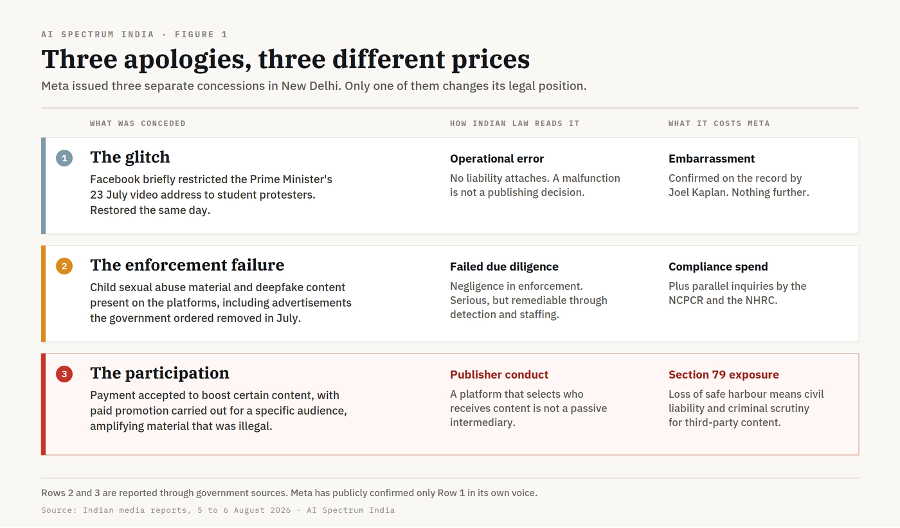
FIGURE 1 Three apologies, three different prices. Rows 2 and 3 are reported through government sources. Meta has publicly confirmed only Row 1 in its own voice.
The trap Meta walked into was already set
None of this happened in a policy vacuum. India spent the first half of 2026 rebuilding exactly the doctrine that Meta has now handed the government a live test case for.
The Ministry of Electronics and Information Technology notified the Information Technology (Intermediary Guidelines and Digital Media Ethics Code) Amendment Rules, 2026 in February, blurring the boundary between being a passive conduit and an active regulator of content. Urgent takedown windows that previously ran to 36 hours were cut to three, certain categories of harmful content must come down within two, and grievance response times fell from fifteen days to seven. The amendment also introduced a formal definition of synthetically generated information covering audio, visual and audiovisual content created or altered through any computer resource.
The provision that matters most for this week’s events is the one dealing with knowledge and capability. Significant social media intermediaries are deemed to have failed due diligence if they knowingly permitted or promoted unlawful synthetic content, or failed to act on it, when the technical means of detection were available to them. The word doing the work there is promoted. The rules already anticipated a platform that does not merely host, and India now says it has one on the record.
A draft second amendment circulated on 30 March goes further still, reframing Section 79 protection from a rules based entitlement into a privilege that has to be continuously earned. This week gives that draft its case study.
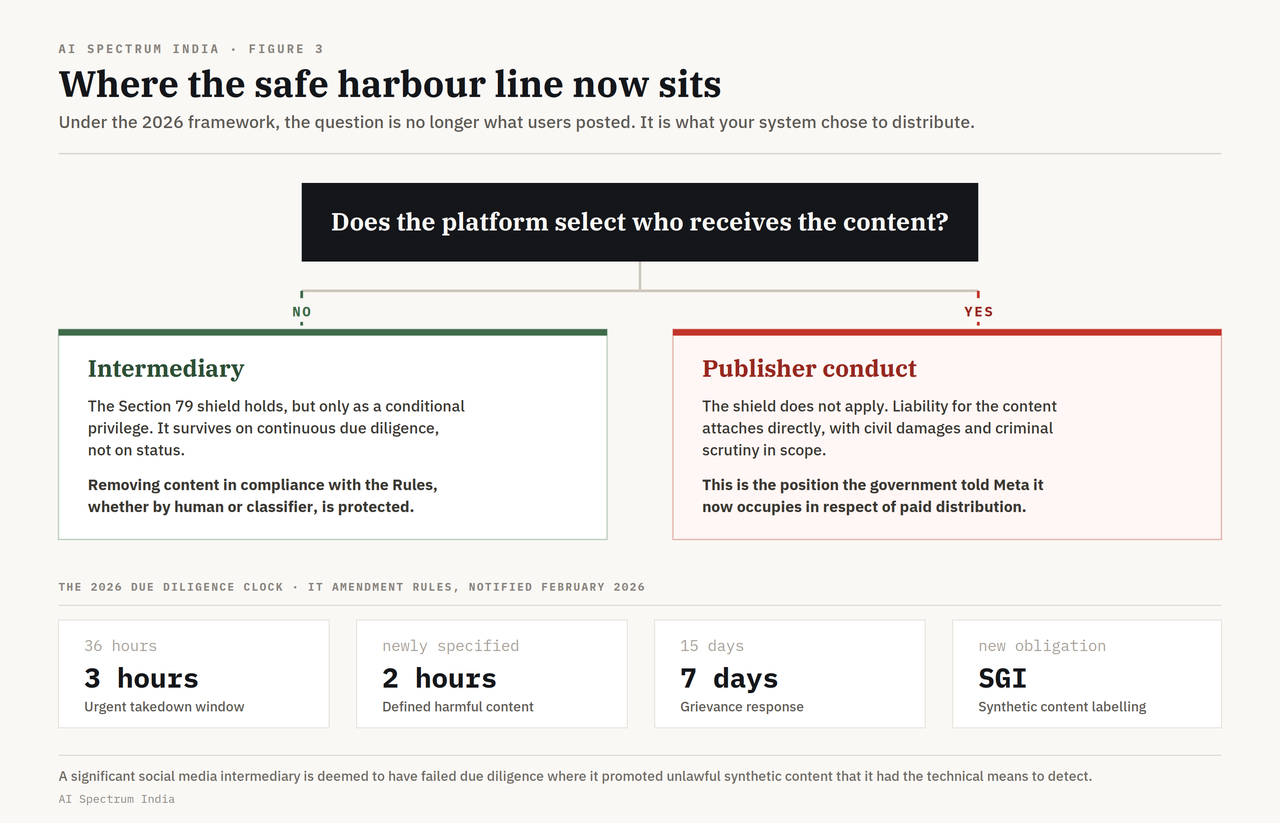
FIGURE 3 Where the safe harbour line now sits. The 2026 amendment ties protection to conduct rather than to status, and attaches liability to detection capability.
The AI question nobody in the room said out loud
For readers of this publication, the most consequential aspect of the story is not political. It is architectural.
Every element of what Meta apologised for is the output of a model. Ad approval is a classifier. Audience selection is an optimiser. Amplification is a ranking system trained to maximise engagement within advertiser specified targeting parameters. Nobody at Meta sat in a room and decided to deliver illegal advertising to a particular cohort of Indian users. A pipeline did, because the pipeline was doing precisely what it was built to do.
That is the defence, and it is also the problem. The argument that the algorithm did it used to function as an exculpation. Under the 2026 framework it functions closer to a confession, because the rules attach liability to capability. If you could have detected it, and your system promoted it anyway, the automation is not a shield. It is the evidence.
This is where Indian regulation has quietly diverged from the American model and moved closer to the European one, while doing something neither has done cleanly. The Indian rules explicitly provide that removing content in compliance with the Rules, whether by human reviewer or automated classifier, will not itself be held against the platform under Section 79(2), closing off the perverse incentive that has bedevilled the Section 230 debate in the United States. Moderate aggressively and the law backs you. Rank commercially and you own the outcome.
For any company deploying recommendation, targeting or generative systems in India, and that now includes retailers, fintechs, streaming services, ed-tech platforms and news aggregators, the governance implication is direct. Model documentation is no longer an internal ethics exercise. It is the record that determines whether your distribution decisions were negligent or deliberate. Ad ranking logs, targeting parameter histories, classifier confidence thresholds and override decisions are all now potentially discoverable artefacts in a liability argument.
What we do not yet know
A responsible reading requires marking the limits of the record, and they are significant.
The most damaging material in this story, the paid promotion admission, comes from government sources speaking to Indian media, not from Meta. As of Wednesday, Meta had not publicly released a detailed statement from Zuckerberg addressing the reported admission about paid content promotion. The only element Meta has confirmed on the record in its own voice is Kaplan’s apology for the restriction of the post.
Nor is the scope of the admission clear. There is a wide gap between our ad system approved advertisements that should have been rejected, and those advertisements were then targeted using standard tools, and Meta knowingly accepted payment to promote unlawful material. The first is a failure of automated review at scale, which is serious and familiar. The second is a different order of allegation. The reporting so far does not settle which of the two the company conceded, and the difference is worth several billion dollars and a criminal exposure question.
There is also a legitimate contrary reading of the regulatory direction itself, and it deserves airing rather than burial. Legal commentators have noted that the enhanced due diligence obligations, compressed takedown timelines and expanded content regulation raise real concerns about free speech, executive overreach and procedural safeguards. Making executive directions themselves the compliance standard concentrates regulatory power, and it does so in a manner that is likely to attract constitutional challenge. A framework in which safe harbour must be continuously re-earned through compliance with directions is also a framework in which the threat of withdrawal becomes an everyday instrument of leverage over speech. Both things can be true: Meta’s conduct can warrant serious scrutiny, and the tool being sharpened on Meta can be one that eventually gets used on far smaller and far less powerful publishers.
What to watch next
Four things will tell us whether this was a bad news cycle or a turning point.
Whether Meta issues its own statement. A signed, detailed statement from Zuckerberg on the paid promotion question would confirm the admission and effectively concede the intermediary argument. Continued silence suggests the company intends to contest the characterisation later, and that the government’s version is doing work that Meta will not endorse.
Whether a formal determination follows. Sources indicated Meta will be called back over these concerns. An apology absorbed informally is manageable. A written finding that Meta operates as a publisher rather than an intermediary in respect of paid distribution is not, and it would apply well beyond Meta.
The second amendment rules. If the March draft is notified in something close to its current form, the leverage demonstrated this week becomes routine procedure.
Advertiser behaviour. This is the commercial tell. If Indian brand safety teams start demanding audit rights over placement and targeting logs rather than accepting post-hoc exclusion lists, the cost of this episode lands on Meta’s revenue line rather than its legal department, and it lands quickly.
The Immediate Crisis
Meta got the outcome it came for. The parliamentary deadline was met, the minister accepted the apology, and the immediate crisis is contained.
But the company paid for that containment with a sentence about paid promotion that Indian regulators have been waiting years to hear a platform say out loud. India spent 2026 constructing a legal framework premised on the argument that platforms which choose what users see are not neutral conduits. This week, in the government’s telling, the largest platform in the country agreed.
Apologies expire. Admissions do not.
|
A NOTE ON SOURCING This analysis draws on reporting by ANI, Moneycontrol, Republic, Indian Television and other Indian outlets between 5 and 6 August 2026, and on published legal commentary on the Information Technology (Intermediary Guidelines and Digital Media Ethics Code) Amendment Rules, 2026. The account of what Meta conceded regarding paid promotion rests on unnamed government sources. Meta has confirmed only the apology for the restriction of the Prime Minister’s post in its own voice. Readers should treat the wider admission as reported rather than established until the company addresses it directly. |
AI Spectrum India covers the business of AI and industrial transformation, published by MM Activ Sci-Tech Communications. Understanding AI is a business advantage, not an option. | www.aispectrumindia.com