

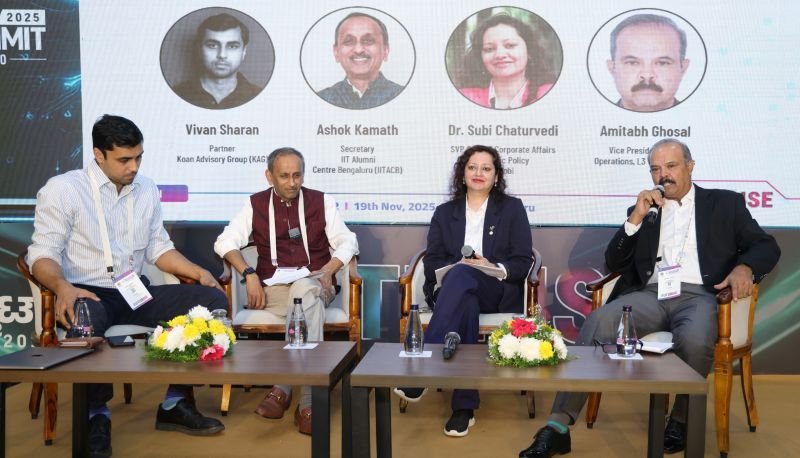
Agentic AI defined as systems that can plan, reason and collaborate seamlessly with humans is rapidly moving from concept to real world deployment. The panel highlighted that these systems are not just enhancing productivity but reimagining entire workflows across logistics, education, agriculture, defence and large scale enterprise operations.
Speaking at the discussion, Vivan Sharan, Partner at Koan Advisory Group, emphasised that agentic systems are fundamentally changing how organisations interpret tasks and make decisions. He noted that the India United States innovation corridor offers a timely opportunity to co develop frameworks that balance ambition, trust and accountability.
Ashok Kamath, Secretary at IIT Alumni Centre Bengaluru, shared that the education sector stands to gain significantly from autonomous learning agents that can personalise instruction, assist educators and help institutions widen access to quality learning at scale. He underscored that India’s vast talent pipeline will be central to accelerating adoption.
Providing an enterprise vantage point, Dr Subi Chaturvedi, Senior Vice President for Public and Corporate Affairs at InMobi Group, noted that the intersection of policy, safety standards and industry readiness will determine the pace at which agentic systems are deployed responsibly. She highlighted the need for forward looking regulation that protects consumers while enabling innovation.
Representing mission critical operations, Amitabh Ghosal, Vice President Operations at L3 Harris, outlined how autonomous and semi autonomous agents are reshaping defence and security frameworks through improved situational awareness, faster decision support and enhanced operational resilience. He added that trusted India United States collaboration is essential to strengthen global security architectures.
Across the session, experts agreed that the future of Agentic AI will be shaped by strategic cooperation, inclusive design and the ability of organisations to integrate human judgement with machine scale capabilities. With both India and the United States investing deeply in frontier technology, the corridor is poised to unlock new economic value and shared innovation outcomes.