

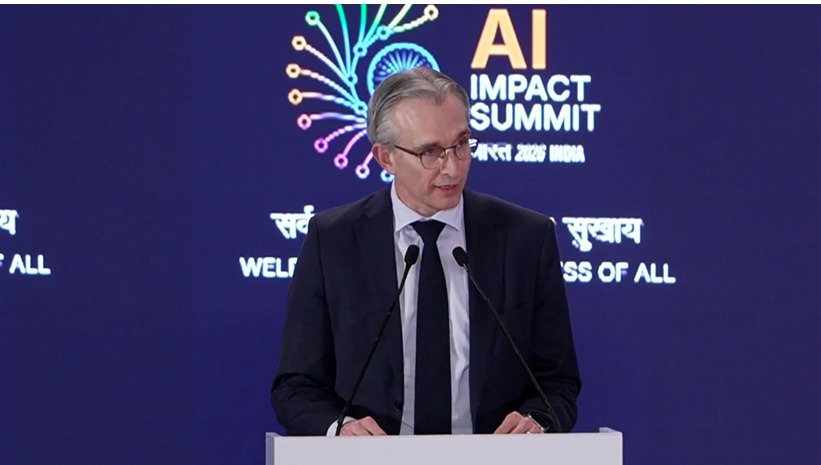
Roy Jakobs, Chief Executive Officer of Philips, used his AI India Impact Summit 2026 address to land a clear point: artificial intelligence will have its biggest impact in healthcare because healthcare is under pressure and because the system cannot wait.
Rather than pitching a distant future, Jakobs outlined what he called the first practical wave of AI in hospitals and clinics, focused on removing friction, returning time to clinicians, and improving consistency in diagnosis and monitoring. His message was grounded in reality: demand is rising, chronic disease is climbing, workforces are stretched, and expectations from patients and society are only increasing.
“We believe that artificial intelligence will have its biggest impact in healthcare because healthcare needs it.”
The Core Argument: Healthcare Is Finally Ready To Move Faster
Jakobs acknowledged that healthcare has historically adopted technology cautiously, for good reason. Yet he argued that something fundamental has changed: the pressure on health systems is now forcing a faster shift towards data and AI driven innovation.
He framed the priority as building an intelligent care system that is predictive, trusted, more effective, and accessible for people everywhere. He also made a point many in the room will recognise: the success metric is not the technology itself, it is the people served by it.
“Ultimately it is not about AI or technology. It is about the people that are served by technology and AI.”
Time Back For Clinicians: The First Wave That Actually Matters
If there was one operational takeaway, it was this: clinicians lack time. Jakobs argued that the first wave of AI will quietly transform care by automating repetitive steps, reducing clicks, supporting documentation, and making systems more intuitive.
He gave concrete examples that directly map to current clinical workflows:
“When AI listens to a clinical conversation and drafts structured documentation in the background, that is not replacing a clinician. It is giving time back to the clinician.”
“When AI prioritise work lists so that the most urgent cases rise to the top, it is not making decisions independently. It is supporting better clinical judgement.”
His framing was deliberate: AI should augment human expertise, not replace it, and the best early deployments will be those that clinicians feel as relief, not disruption.
From Backlogs To Consistency: Autonomous MRI As A Proof Point
Jakobs then moved from workflow to imaging, using the familiar story of scan backlogs, stressed technologists, and limited specialist availability. He described an autonomous MRI experience where AI assists positioning, selects optimal protocols, and continuously monitors image quality during the scan.
The point was not theatre. It was throughput and consistency: more patients diagnosed earlier, reduced variability, scaled expertise, and lower cost of care over time. He also linked this to Philips investments in integrated MR workflows, AI engines that scan faster while enhancing quality, and helium free MRI systems that improve sustainability and widen deployment options beyond traditional hospital settings.
The Smart Hospital Room: Agentic AI Under Guard Rails
Jakobs painted a second scenario, the hospital room drowning in devices, alarms, and dashboards. His alternative was a smart healing environment where device data flows into a unified platform and AI continuously analyses trends, reducing false alarms and elevating true risks earlier.
He introduced agentic AI carefully, with guard rails and human oversight as the non negotiable foundation.
“That is the power of agentic AI software that can perceive, reason, and act within defined guard rails, always under human oversight.”
Trust As The Real Bottleneck
Jakobs was blunt that healthcare runs on trust, and without trust, adoption stalls. He argued AI must be transparent, continuously validated, and aligned with evolving regulatory frameworks. Clinicians must understand how recommendations are generated, patients must trust data protection, and regulators must see rigorous monitoring of safety and efficacy as an ongoing discipline.
“Innovation and governance must advance together with speed because trust determines adoption and adoption determines the success of valuable application of AI in healthcare.”
Why India Matters: Scale, Data Infrastructure, And A Global Innovation Engine
Jakobs positioned India as a uniquely powerful arena for this transformation, describing the country as standing at the intersection of scale, digital infrastructure, and ambition. He referenced national digital health foundations enabling interoperable records and longitudinal data, and noted that structured, high quality longitudinal data increases the power of predictive analytics dramatically.
He also highlighted India’s real world complexity at scale, across urban and rural settings, public and private systems, tertiary hospitals and primary health centres. In his framing, this complexity is not a drawback, it is the proving ground for resilient solutions that can inform global models of care.
Jakobs reinforced Philips long presence in India and described it as a global innovation engine, pointing to major investments in R and D, manufacturing, digital platforms, AI engineering, and clinical collaboration through facilities in Bengaluru and Pune. He cited more than 4,000 engineers in India building for India and for the world, with work spanning imaging, monitoring, and connected care.
Outcomes Over Algorithms
Jakobs closed with a future facing metric: in ten years, success will not be defined by the number of algorithms deployed, but by outcomes. Earlier detection, fewer avoidable complications, shorter waiting times, greater access, and more time for clinicians, nurses, and technicians.
He also cited optimism in India from both clinicians and patients on AI improving outcomes and personal healthcare, positioning readiness as an advantage.
“It will not be remembered for what is optimised on the screen, but for the billions of lives that we could improve with it.”