

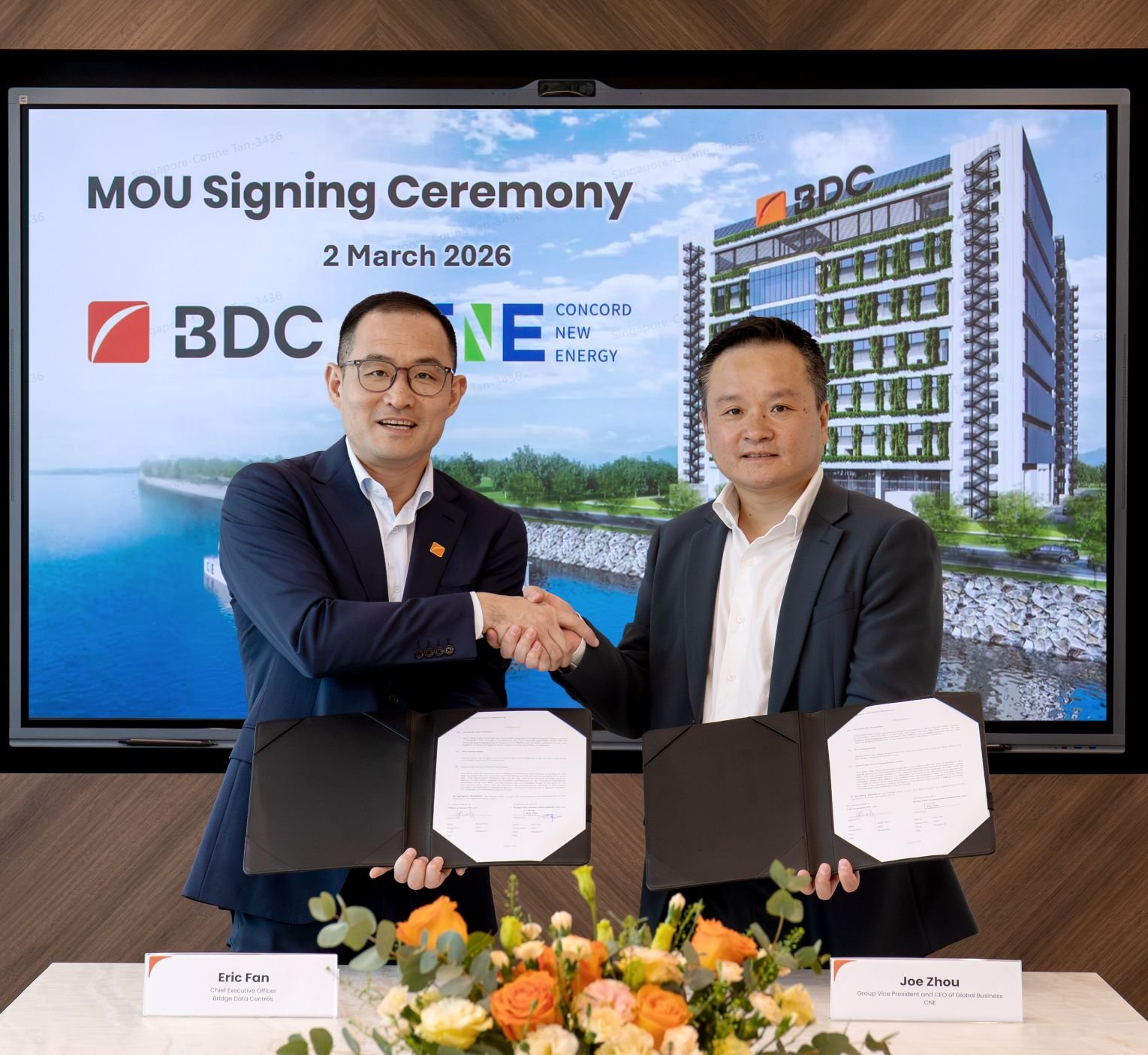
Bridge Data Centres (BDC) and Concord New Energy (CNE) have signed a Memorandum of Understanding to jointly develop Singapore’s first barge-based hydrogen power generation solution designed for next-generation AI data centre infrastructure.
The initiative marks a step toward low-carbon energy solutions for the rapidly expanding data centre sector and forms part of BDC’s broader strategy to diversify power sources, enhance energy security, and prepare its Singapore portfolio for rising demand and grid constraints.
The collaboration combines BDC’s experience in building and operating hyperscale data centres across the Asia-Pacific region with CNE’s expertise in renewable and hydrogen energy systems. The project will also involve research collaboration with Nanyang Technological University (NTU) to support the development of Singapore’s hydrogen ecosystem and accelerate the deployment of scalable clean energy technologies.
A central element of the partnership is the development of a barge-based hydrogen power generation model. The marine-integrated approach is designed to deliver flexible and modular clean energy capacity for AI-ready data centre campuses.
Compared with conventional land-based facilities, the barge-based model offers several advantages, including better utilisation of Singapore’s limited land resources through offshore or near-shore deployment. It also allows hydrogen handling infrastructure to be separated from core data centre operations, improving safety while enabling flexible hydrogen transport and storage through Singapore’s maritime network.
The partners will also explore integrated renewable energy pathways, including hydrogen storage and transport frameworks, energy storage systems, and long-term renewable power purchase agreements to strengthen supply reliability.
According to Eric Fan, the rapid growth of AI-ready data centres requires new energy models that are resilient and sustainable.
CNE’s global business CEO Joe Zhou said Singapore’s role as a maritime and energy hub makes it an ideal location to pilot advanced hydrogen power systems.
The partnership is expected to support Singapore’s clean energy ambitions, while fostering local talent development and investment in hydrogen infrastructure as the country expands AI-driven digital infrastructure.