

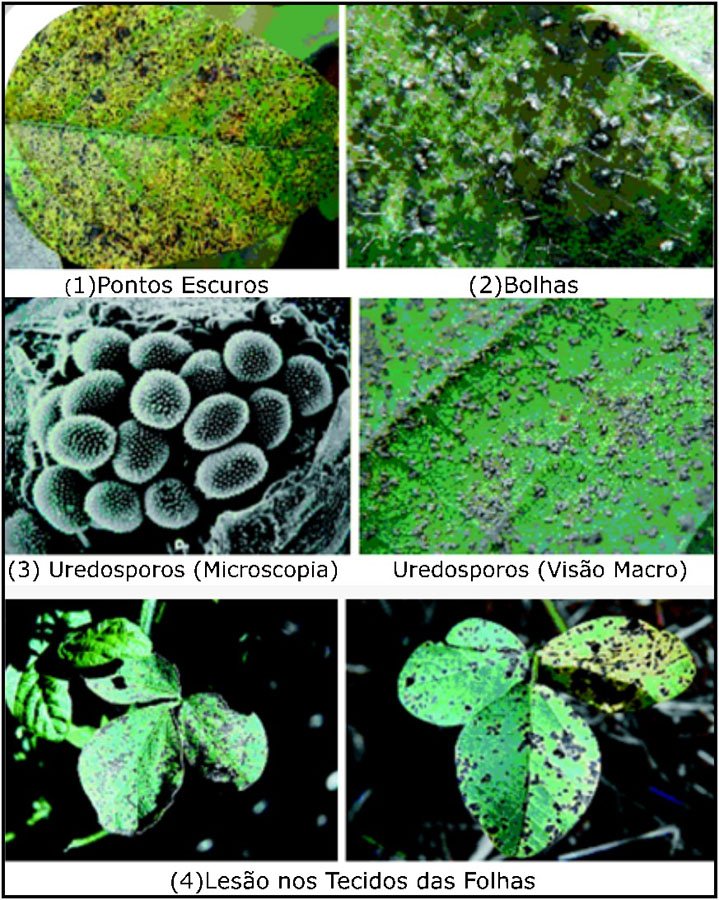
Brazilian scientists have developed a platform to diagnose Asian soybean rust, one of the most severe diseases to affect the crop. The technology integrates artificial intelligence (AI) with the combined analysis of climate, agronomic, and digital image data. The cloud-based system assesses the risk of disease occurrence and generates reports with technical management recommendations, contributing to more accurate decisions in the fields.
The tool gathers data from environmental sensors, digital images of leaves, and agronomic parameters such as cultivar, spacing, and sowing schedule. The results are presented in an online dashboard, which allows farmers to track time series of climate data and plant images.
The system was developed as part of the Advanced Digital Tool for Agricultural Risk Management project, with funding from the São Paulo State Research Foundation (Fapesp). The initiative was part of computer scientist Ricardo Alexandre Neves' doctoral studies at the Federal University of São Carlos (UFSCar), with Paulo Cruvinel, a researcher at Embrapa Instrumentation (SP), as advisor.
The study A Cloud-Based Intelligence System for Asian Soybean Rust Risk Analysis in Soybean Crops was published in July 2025 by the journal AgriEngineering.
The scientists developed the system through on-farm research, using a model that incorporates climate variables, data related to soybean plants, and data obtained from digital images of soybean leaves. Climate variables were observed during the area monitoring period.
“The technology classifies disease favorability into three levels: low, medium, and high, depending on the combination of variables that relate to the stage of infestation. That allows diagnoses and prognoses for disease control with higher effectiveness and accuracy," Neves adds. According to him, the level of favorability is defined by statistical inference based on the behaviour of the set of variables.
The researchers explain that the system works by combining data. The main ones enable the analysis of factors that are essential to the development of the fungus, such as the leaf wetness period, relative humidity above 90 per cent, in the temperature range between 15°C and 28°C, or the dew point.
The work uses advanced and specific processing techniques to extract information from digital images of soybean leaves. Colour patterns, such as green, yellow, and brown, are associated with the stages of disease progression.
Cruvinel reports that, to merge the data, the study evaluated two methods. In the end, the choice for the system was the Hidden Markov Chains model, which provides robustness, effectiveness, and efficiency to the decision-making process. This methodology proved to be superior to fuzzy logic, achieving 100% accuracy in matching the scenarios evaluated for the risk of Asian rust occurrence in soybean areas.
“The model that was developed to merge data on different variables made it possible to structure a complete set of rules that systematically considers different situations in which the disease is likely to occur,” the researcher says.
During the four-year study with Embrapa Soybean’s conventional cultivar BRS 536, researchers used more than 2 gigabytes of data per crop cycle, considering information collected in actual fields during cultivation, in georeferenced plots in the Poxoréu-MT region and photographed under known lighting indices.