

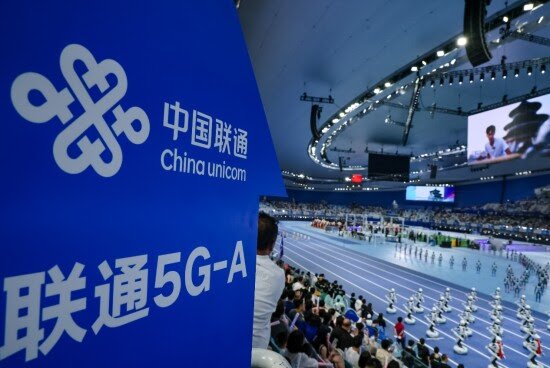
China is showcasing the growing capabilities of humanoid robots and embodied artificial intelligence (AI) at the 2nd World Humanoid Robot Games, where 2,056 humanoid robots from 666 teams are competing across 51 events at Beijing’s National Speed Skating Oval, known as the “Ice Ribbon”.
The Games, which opened in Beijing, have expanded significantly from the inaugural edition, with the number of events increasing from 26 to 51. This year’s programme includes 1,301 competitions, spanning head-to-head events such as table tennis and kickboxing, as well as scenario-based challenges modelled on industrial production, hotels, homes and logistics.
The event is also serving as a real-world testbed for the connectivity requirements of embodied AI, as robots increasingly need to perceive their surroundings, make decisions and execute precise movements in dynamic environments.
China Unicom Beijing and Huawei have deployed an integrated digital infrastructure based on a 5G-A GigaUplink network to support robot competitions and event operations.
The network is designed to address the demanding connectivity requirements of increasingly autonomous humanoid robots, including high-capacity uplink, low latency and high reliability. These capabilities are required to transmit real-time robot telemetry, control signals and coordination data between multiple robots.
A dedicated 100 MHz network, complemented by a 300 MHz LampSite ultra-wideband indoor network, has been deployed at the venue. A dedicated 5QI 7 network slice combined with carrier isolation is designed to keep end-to-end latency for humanoid robots within 30 milliseconds.
On-site testing recorded a peak uplink speed of 1 Gbps, with average latency below 30 milliseconds.
The connectivity infrastructure is intended to support applications including real-time decision-making, multi-robot coordination, obstacle avoidance and fine-motion control, where delays in communication can affect robotic performance.
The network has also been integrated with BeiDou RTK (Real-Time Kinematic) positioning, providing decimetre- to sub-decimetre-level positioning accuracy.
The combination of high-speed connectivity and precise positioning can support autonomous navigation, obstacle avoidance and precision racing in complex environments. Such capabilities are becoming increasingly important as humanoid robots move from controlled demonstrations towards applications in real-world environments.
This year's Games feature more autonomous competition formats and significantly more complex tasks than the inaugural event. The expansion is intended to test robots' ability to operate in environments that more closely resemble industrial and everyday settings.
The deployment reflects a broader effort to build connectivity infrastructure capable of supporting embodied AI and Mobile AI applications beyond dedicated robotics events.
Scenario-based competitions at the Games include tasks linked to industrial production, hospitality, household environments and logistics. Dance competitions also require multiple robots to synchronise their movements, placing additional demands on communication and coordination.
The combination of autonomous robots, real-time connectivity and precise positioning demonstrates how telecommunications infrastructure is becoming an important component of the embodied AI ecosystem. As humanoid robots increasingly interact with physical environments, reliable low-latency networks can enable robots to exchange information and coordinate actions in real time.
China Unicom said the infrastructure deployed for the Games is intended to provide a foundation for humanoid robots to move beyond competition arenas and into everyday applications.
Alongside robotic operations, the 5G-A network is being used to manage connectivity for large numbers of spectators at the event.
Network resources and service-assurance policies are being dynamically adjusted across different stages of the event, including admission, waiting, competitions and departure. Essential services such as QR-code admission, ticket enquiries, mobile payments and messaging are prioritised, while the network also supports high-bandwidth activities including video uploads, short-form video sharing and live streaming.
The Games therefore provide a demonstration of how 5G-A connectivity can simultaneously support AI-driven machines and high-density human users, highlighting the expanding role of advanced networks in future AI-enabled environments.