

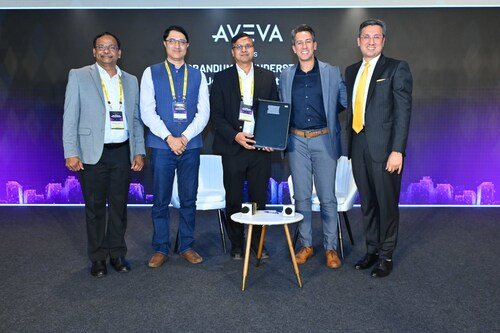
AVEVA, a global leader in industrial software, announced a broad set of upcoming innovations for its industrial intelligence platform, CONNECT. Addressing the mounting challenge of data silos in the modern enterprise, the company is announcing a revolutionary industrial knowledge graph and a twin builder that applies agentic AI, slated for release in Q1 2027. By establishing a robust semantic model, this framework will act as the underlying architectural schematic that AI requires to deliver truly useful, accurate, and trusted outputs. Rather than feeding AI raw, disjointed information, this framework provides critical operational context by mapping the complex relationships between physical assets, empowering industrial teams to troubleshoot faster and make high-impact decisions with confidence.
The updates will make it faster and simpler for industrial organisations to put the full breadth of their industrial data to work, driving better decisions, stronger compliance, and AI-enhanced intelligent operations.
For industrial organisations, the pressure to adopt AI is intensifying, and so are the underlying challenges: complex regulatory environments, a growing sustainability imperative, ageing infrastructure and fragmented data. Today, up to 73 per cent of all data collected within enterprises goes unused. Furthermore, 76 per cent of business leaders report finding it difficult to understand their data. CONNECT bridges this gap by leveraging the cloud to empower ecosystems securely and seamlessly across the value chain, driving exponential business growth.
"For industrial enterprises globally, the challenge is not ambition but infrastructure," shared Zubin Davar, VP – CONNECT Platform GTM. "The promise of AI remains largely unrealised for most industrial teams because operations data, engineering data, asset context, workflows, and compliance frameworks all need to be managed in one place without losing fidelity, lineage, or meaning. CONNECT is designed to close this gap across every layer of deeply heterogeneous industrial technology stacks. By lowering the cost and complexity of unifying industrial data, we help customers turn fragmented data into trusted intelligence, accelerating their AI-driven transformation."