

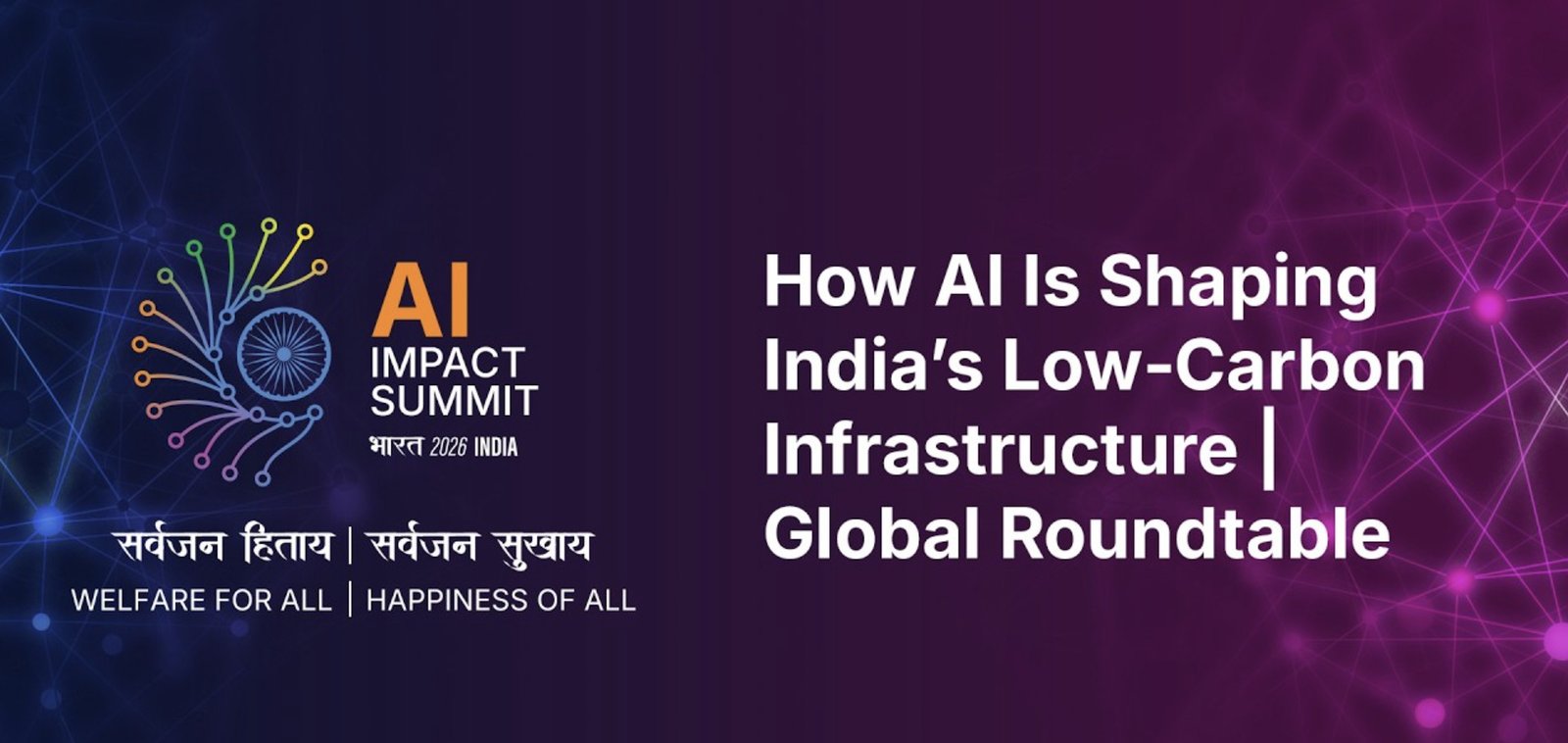
The session titled How AI Is Shaping India’s Low Carbon Infrastructure brought together voices from industry, research, innovation ecosystems and sustainability focused organisations for a timely and grounded discussion on how artificial intelligence can accelerate India’s climate ambitions. Hosted at Bharat Mandapam, the roundtable explored the growing role of AI in supporting decarbonisation, circularity and sustainable infrastructure development at scale.
India currently stands at a decisive moment where rapid infrastructure growth must align with climate responsibility. Against this backdrop, the conversation moved beyond theoretical optimism and instead focused on practical applications, systemic challenges and collaborative pathways that can transform AI from a promising tool into a structural enabler of low carbon progress.
From the beginning, the discussion established a clear narrative that artificial intelligence is no longer confined to digital experimentation. Instead, it is increasingly becoming a layer of intelligence embedded into real world systems such as mobility networks, energy management, manufacturing operations and waste ecosystems. This shift formed the foundation of the session’s reflections.
AI As An Operational Enabler
One of the strongest themes that emerged was the role of AI in improving operational efficiency across infrastructure systems. Panel members observed that many carbon reduction opportunities already exist within existing operations. The challenge is not always the absence of technology but rather the lack of intelligence required to optimise resource usage.
Bishakha Bhattacharya emphasised this shift when she noted that,
“AI is no longer a future concept for sustainability. What matters now is embedding intelligence into everyday infrastructure decisions so that carbon reduction becomes automatic rather than aspirational.”
Her insight reflected a broader consensus that AI allows organisations to transition from reactive management to predictive and proactive decision making. Predictive maintenance, energy demand forecasting, and system optimisation were discussed as examples where emissions reductions can occur without significant physical expansion.
Participants highlighted that the real potential lies in integrating AI into ongoing infrastructure modernisation efforts. Rather than treating sustainability as a separate initiative, AI can quietly improve efficiency in the background, delivering environmental benefits alongside cost savings.
Circularity And The Intelligence Of Materials
The conversation naturally extended from decarbonisation to circular economy models. Speakers agreed that India’s growth trajectory demands smarter use of resources, making circularity a strategic priority rather than a secondary sustainability objective.
AI was described as a powerful enabler for mapping material lifecycles, improving waste segregation and supporting reuse strategies. Data driven visibility across supply chains emerged as a recurring idea. Without clear tracking of material flow, circular economy efforts remain fragmented.
Vedant Taneja summarised this perspective by stating,
“Decarbonisation is ultimately an optimisation problem, and AI allows us to test and refine solutions faster than traditional approaches.”
The discussion recognised that circularity is fundamentally a systems challenge involving manufacturers, cities, logistics players and policymakers. AI provides the analytical foundation, but collaboration remains essential for meaningful outcomes.
Data As The Core Constraint
While optimism around AI’s potential was evident, panellists also acknowledged that implementation challenges remain significant. Chief among these is data availability and quality.
Debajit Palit observed that,
“Technology alone will not deliver climate outcomes. The real shift comes when policy, data access, and local context align with innovation.”
This perspective sparked discussion on governance frameworks and the need for shared data standards. Fragmented datasets, inconsistent reporting practices and limited interoperability were identified as barriers preventing AI solutions from scaling across sectors.
The panel agreed that data should be viewed as climate infrastructure in its own right. Investments in data infrastructure and governance may determine whether AI remains limited to pilots or evolves into a national scale transformation tool.
Innovation Ecosystems And The Startup Role
A compelling element of the conversation was the role of startups and innovation ecosystems in bridging ideas and execution. Startups were recognised for their agility and ability to experiment rapidly with new models.
Anand Sri Ganesh highlighted this dynamic by noting,
“Startups play a crucial role because they experiment rapidly. The challenge is creating pathways to help innovations scale into real infrastructure deployments.”
This insight reflected a broader industry reality. Many AI solutions demonstrate strong promise at pilot stage, yet scaling remains difficult due to funding gaps, regulatory uncertainty and limited access to large infrastructure systems.
The discussion suggested that accelerators, knowledge partnerships and collaborative pilot programmes can help bridge this gap by connecting young innovators with enterprise scale deployment opportunities.
Industry Perspectives And Mobility Applications
Representatives from established industry players brought practical perspectives on adoption challenges and opportunities. Transport and mobility emerged as key sectors where AI can produce measurable sustainability gains.
Sapna Bhawnani remarked,
“Transport infrastructure is a strong use case for AI driven predictive systems that improve efficiency while reducing long term emissions.”
Similarly, Rohan Chhatwal emphasised the growing importance of data driven decision making across value chains, noting that sustainable mobility will increasingly depend on intelligent data usage from manufacturing through to consumer operations.
These perspectives illustrated that industry adoption is already moving forward, though success relies on integrating AI into operational workflows rather than treating it as a stand alone technology initiative.
Global Collaboration And India’s Opportunity
The roundtable also reflected on India’s potential role within the global sustainability landscape. Lena Robra observed,
“India has a strong opportunity to lead by building scalable, globally relevant models for AI driven sustainability that emerging economies can replicate.”
This viewpoint positioned India not only as an adopter but as a potential creator of scalable sustainability models designed for complex and diverse infrastructure environments. The combination of scale, digital capability and cost conscious innovation was repeatedly identified as a distinct advantage.
As the session concluded, a clear message emerged. The conversation around AI and sustainability is maturing. It is no longer about proving that AI can contribute to climate action. Instead, the focus has shifted towards building practical frameworks that allow responsible and scalable adoption.
The roundtable highlighted that success will depend on three interconnected pillars. First, integrating AI into infrastructure operations rather than treating it as an external layer. Second, strengthening data governance and interoperability to support meaningful analytics. Third, building collaborative ecosystems where policymakers, industry leaders, researchers and startups work in alignment.
Ultimately, the discussion reinforced a powerful idea. India’s path towards low carbon infrastructure will be shaped not by isolated technologies but by intelligent systems thinking where AI acts as the connecting force between sustainability ambition and real world implementation.
The session closed with optimism grounded in realism. The tools are emerging, the intent is visible, and collaboration is growing. The next step lies in execution at scale, where AI shifts from enabling conversations to enabling measurable climate outcomes.