
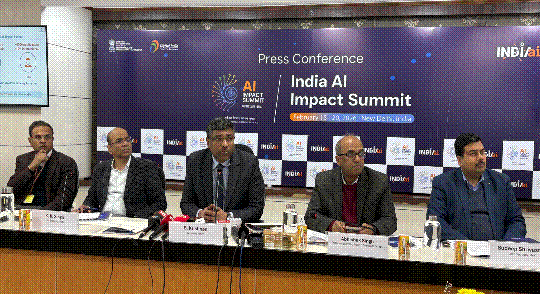
India will host the India AI Impact Summit 2026, a global forum aimed at advancing inclusive, responsible and impact-driven artificial intelligence, the Ministry of Electronics and Information Technology (MeitY) said while briefing the media in New Delhi.
The press conference was chaired by S. Krishnan, Secretary, MeitY. Addressing the media, Krishnan said the Summit aims to democratise artificial intelligence and bridge the emerging global AI divide. He noted that AI capabilities are increasingly concentrated in a small number of geographies and companies, and stressed the need to make AI a widely accessible, horizontal enabling technology. This includes equitable access to critical AI infrastructure such as compute, data and models, enabling countries to develop context-specific AI solutions for sectors including healthcare, agriculture, education, governance and manufacturing.
The Human Capital Chakra focuses on equipping people with skills and literacy required for an AI-driven future, emphasising reskilling and inclusive workforce transitions. Inclusion for Social Empowerment addresses linguistic, cultural, and contextual representation in AI systems to ensure they are inclusive by design and locally relevant. The Safe and Trusted AI Chakra advances transparent, accountable, and technology-enabled governance frameworks that can be adopted across regions. Resilience, Innovation and Efficiency prioritises frugal, energy-efficient, and sustainable AI solutions suited for resource-constrained environments. The Science Chakra seeks to expand inclusive AI research ecosystems and global scientific collaboration, particularly in the Global South. Democratising AI Resources focuses on equitable access to datasets, compute, and foundational models, while AI for Economic Growth and Social Good aims to scale proven AI applications across sectors such as healthcare, education, and agriculture.
The Working Group themes have been shaped through months of extensive consultations, including public engagement via the MyGov platform, which received over 600 citizen responses, stakeholder consultations involving more than 500 organisations, and multiple national and international brainstorming sessions held in cities such as Oslo, Tokyo, New York, and Paris.
Krishnan also outlined how the Sutra–Chakra framework will guide the Summit’s agenda and outcomes, ensuring that discussions move beyond aspiration towards measurable, real-world impact.
As a strategic precursor to the India AI Impact Summit 2026, approximately 300 pre-summit events have been organized to bring in diverse perspectives and build momentum ahead of the Summit; out of which 57 pre-summits have been held across 25+ countries. Furthermore, a series of Regional AI Impact Conferences are being organized, ensuring India’s AI roadmap is inclusive and rooted in the aspirations of a Viksit Bharat.
The India AI Impact Summit 2026 is anchored by a set of flagship global initiatives designed to build sustained momentum and demonstrate AI’s real-world impact across People, Planet and Progress. These include three large-scale global challenges—YUVAi, AI by HER, and AI for All, which together have attracted over 15,000 registrations from 135 countries and around 4,700 submissions, with strong Global South participation. Other flagship events include the India AI Tinkerpreneur challenge that will showcase top 50 projects from school students (Class 6 to 12); UDAAN, a global AI pitch fest connecting high-potential startups with investors and policymakers; six international compendiums on AI in Health, Energy, Gender, Agriculture, Education and Disabilities showcasing high-impact public-good use cases; the AI Impact Expo at Bharat Mandapam showcasing global, state, enterprise and startup innovations; and a Research Symposium featuring frontier AI research from Africa, Asia and Latin America. These collectively position the Summit as a global platform for inclusive, applied and impact-driven AI collaboration.