

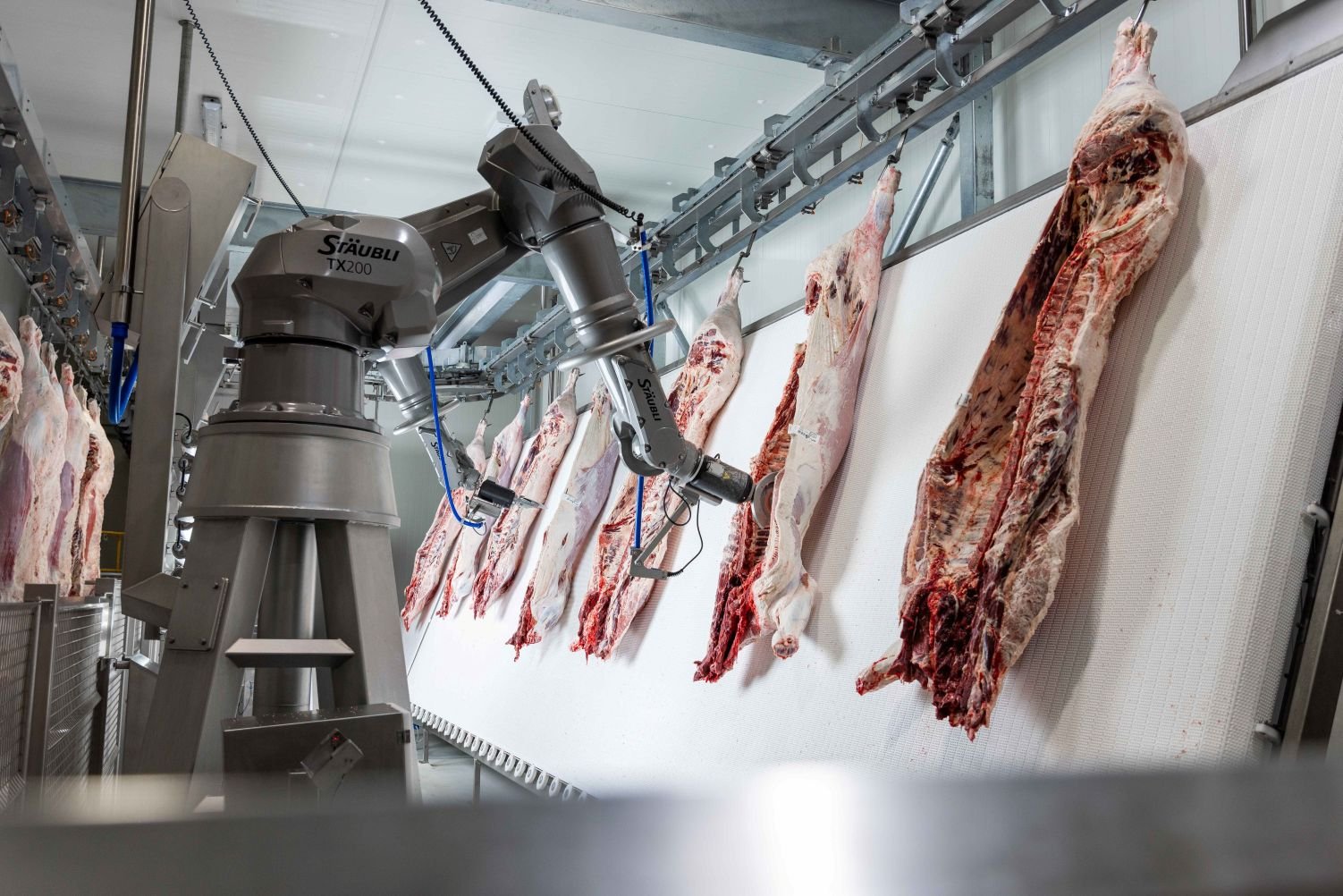
The Australian Meat Processor Corporation (AMPC) has successfully supported the development of AI-driven, fully automated robotic beef scribing systems at two Australian processing facilities, marking a significant step in the adoption of advanced automation in the red meat processing industry.
The technology, developed by Intelligent Robotics in partnership with processors Kilcoy Global Foods (KGF) and Australian Meat Group (AMG), has now been trialled under commercial conditions at both KGF’s Kilcoy facility and AMG’s Cootamundra plant in New South Wales.
Beef scribing is the first step in carcase breakdown and is traditionally one of the most highly skilled, physically demanding and safety-critical tasks on the processing floor. The AI-enabled system uses machine vision and robotics to identify cutting points and perform scribing with a high degree of consistency, removing the need for manual saws.
AMPC Program Manager – Advanced Manufacturing, Stuart Shaw, said the completion of trials at two very different processing sites provides valuable insight into how the technology performs across operating environments.
“Having two variants of the development in full production at both Kilcoy and AMG gives the industry much clearer visibility on performance, integration requirements and what adoption could look like in practice for processors considering automation in safety-critical or highly skilled roles to improve efficiencies,” Shaw said.
At AMG, the system has been running for around nine months at the company’s Cootamundra facility, which can accommodate advanced processing technologies such as automated beef scribing.
AMG Managing Director Gilbert Cabral said the early results were encouraging, particularly in terms of improved accuracy and yield, noting that the project is currently 9 months into an 18-month trial period.
“The trial is at its midpoint,” Cabral said. “We moved forward based on the potential yield benefits, and the initial results are already demonstrating that we can achieve significantly greater detail in our specifications. As the trial continues, further data collection and analysis will build on these outcomes.”