

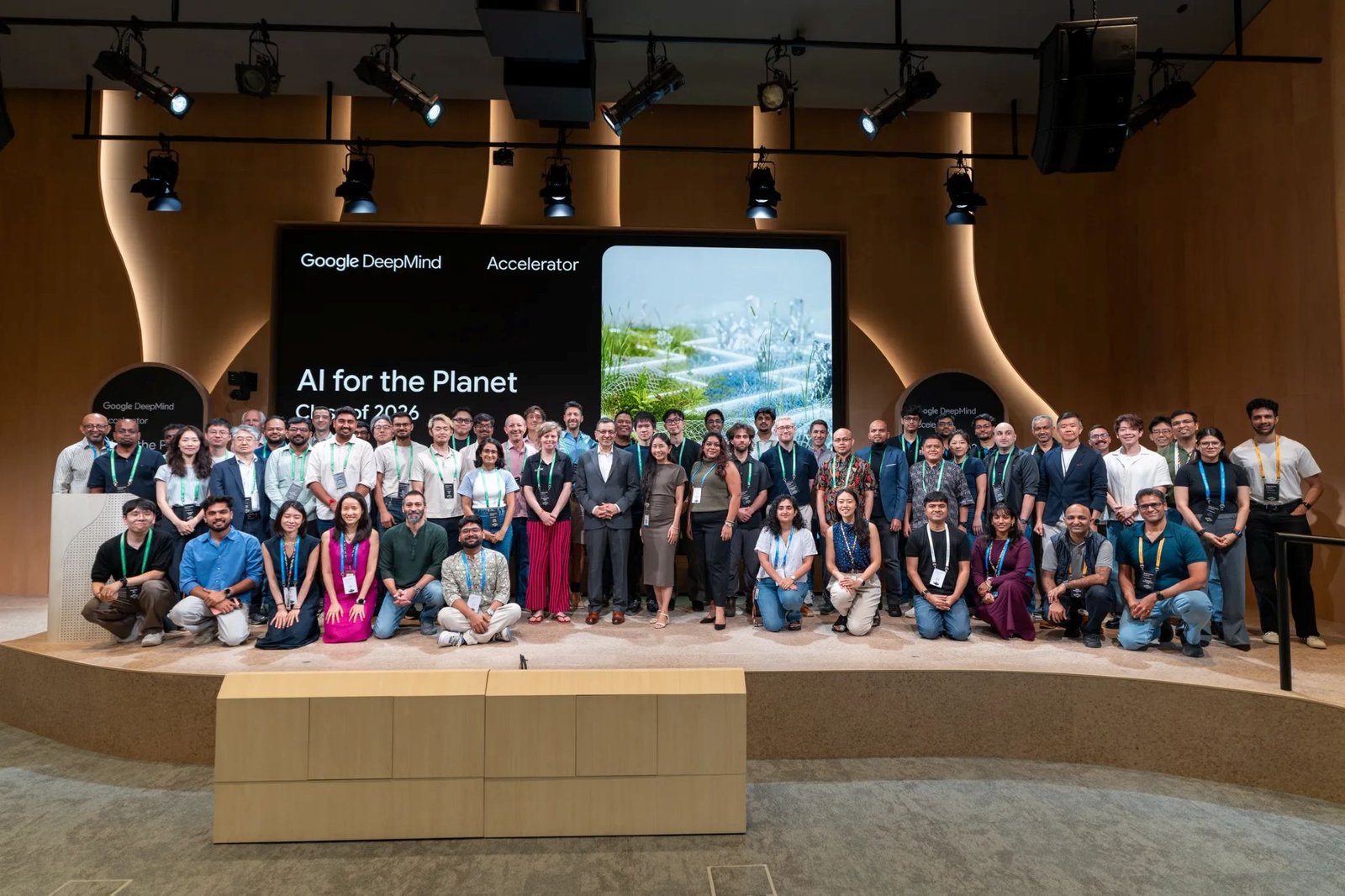
Google DeepMind has selected 16 startups, nonprofits and research organisations from across Asia-Pacific for its Google DeepMind Accelerator: AI for the Planet in APAC, aimed at using advanced artificial intelligence to address environmental and sustainability challenges across the region.
The three-month accelerator kicked off with a hands-on bootcamp in Singapore, bringing together organisations working across biodiversity conservation, sustainable agriculture, climate resilience and carbon solutions. Participants will receive access to Google’s latest AI technologies, including specialised frontier models, along with technical support and mentorship from Google DeepMind experts.
The programme is designed to help participating organisations overcome technical challenges and scale AI-powered solutions addressing environmental issues across the Asia-Pacific region.
Among the technologies being made available to participants are AI models and tools including AnthroKrishi, ForestCast, AlphaEarth Foundations, SpeciesNet and Perch. These technologies have applications ranging from agricultural resilience and forest-risk forecasting to biodiversity monitoring and wildlife identification.
Six organisations selected under the nature and climate resilience category are developing AI applications for biodiversity monitoring, conservation and environmental risk assessment.
New Zealand-based 800 Trust is using AI and bioacoustics to continuously monitor biodiversity and identify environmental threats, while Singapore-based Kumi Analytics combines remote sensing and deep learning to establish environmental baselines for conservation projects.
Listening Lab from New Zealand is developing data-efficient bioacoustic technologies for biodiversity monitoring. South Korea’s TelePIX is applying satellite data to support global mangrove monitoring, while New Zealand-based Wildlife.ai is developing open-source AI-powered cameras for wildlife conservation.
Indonesia’s Yayasan Ekosistem Lestari is developing a predictive AI platform designed to connect environmental degradation with disaster risk.
The accelerator also includes organisations developing AI solutions for farmers and agricultural resilience.
Edufarmers in Indonesia is using everyday messaging applications to provide smallholder farmers with near real-time guidance on pests, diseases and weather. Thailand-based Living Roots is applying data and AI to design biological fertilisers tailored to crop requirements.
Singapore-based SIGMA is developing satellite-based AI models to estimate crop yields and strengthen climate resilience. India’s Terrastack is combining satellite and agronomic data to deliver plot-level land intelligence for smallholder farmers.
Australia’s X-Centric is developing portable, AI-enabled X-ray hardware aimed at replacing traditional soil laboratory testing with rapid geochemical analysis.
The third focus area is climate and carbon, with selected organisations working on carbon measurement, biodiversity, climate action and urban sustainability.
Japan-based Archeda is using satellite data to improve the measurement and integrity of nature-based carbon credits. Singapore’s City Syntax Lab is developing an agentic AI platform designed to optimise energy and carbon management across urban districts.
Three Indian organisations are also part of this cohort. Climitra Carbon is deploying Geo-AI to verify the removal of invasive species and their conversion into biochar, while Farmers for Forests is using AI-powered drones to support measurable carbon and biodiversity action through smallholder agroforestry.
Varaha Climate is applying remote sensing and AI to verify regenerative agriculture and carbon removal, enabling smallholder farmers to participate in carbon-credit programmes.
Over the next three months, the selected organisations will receive access to Google’s AI stack, tailored technical support and mentorship from experts. The programme aims to help participants develop, deploy and scale AI-driven solutions addressing some of the region’s most pressing environmental challenges.
With the inclusion of organisations across conservation, agriculture and climate solutions, the accelerator highlights the expanding role of AI beyond conventional technology applications and its potential to support environmental monitoring, resource optimisation and climate resilience across Asia-Pacific.