

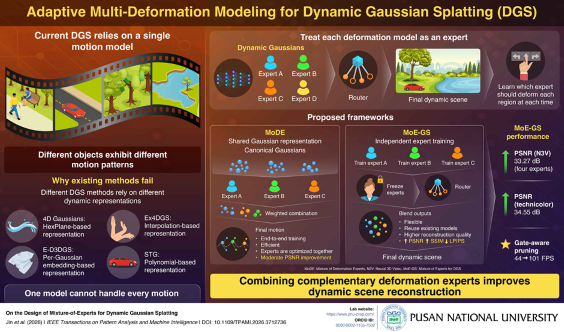
Researchers from Pusan National University have developed two Mixture-of-Experts (MoE) approaches designed to improve the reconstruction of dynamic 3D scenes containing diverse and complex types of motion.
The research addresses a key challenge in dynamic scene reconstruction: no single motion representation consistently performs well across all real-world scenarios. Different Dynamic Gaussian Splatting (DGS) methods have their own strengths and limitations, making it difficult for a single representation to generalise effectively across environments with heterogeneous motion.
To address this challenge, a research team led by Professor Kyeongbo Kong developed two complementary approaches that combine multiple dynamic representations. The first, MoE-GS, independently trains multiple dynamic Gaussian models and uses learned expert routing to adaptively blend their outputs. The second, MoDE, integrates multiple deformation experts during joint optimisation while using a shared Gaussian representation.
Rather than relying on one motion model, the approaches allow specialised models to contribute according to the characteristics of different regions and time steps within a dynamic scene.
“ We conducted a systematic analysis and have come to the understanding that no existing Dynamic Gaussian Splatting method consistently performs best across diverse scenarios. Motivated by this finding, we introduce MoE-GS, the first framework that adaptively combines multiple specialised dynamic Gaussian models through a Mixture-of-Experts architecture instead of relying on a single representation,” said Prof. Kong.
The researchers found that combining complementary experts can improve the reconstruction of complex scenes involving multiple types of motion. The adaptive routing mechanism enables the system to select and combine appropriate experts, improving reconstruction quality while maintaining flexibility across different dynamic environments.
Accurate reconstruction of dynamic 3D environments is important for a range of AI applications, including robotics, autonomous systems, digital twins and immersive spatial computing. Systems operating in physical environments need to understand not only the structure of their surroundings but also how objects and people move within them.
The researchers believe the adaptive approach could contribute to the development of more reliable AI systems capable of modelling complex environments with heterogeneous motion. The work could also support future research into dynamic scene understanding, world models and Physical AI, where AI systems are expected to perceive and interact more naturally with the physical world.