

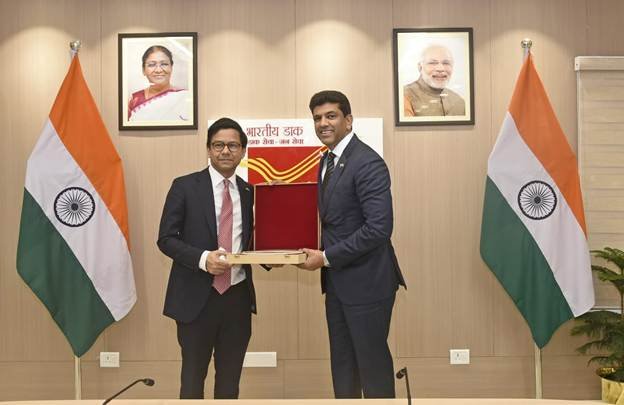
On the sidelines of the AI Summit in New Delhi, Dr Pemmasani Chandra Sekhar, Minister of State for Communications, Government of India, held a bilateral meeting at Dak Bhawan with Kanishka Narayan, Parliamentary Under-Secretary of State for AI and Online Safety, United Kingdom.
The meeting reaffirmed the growing depth of India–UK cooperation in telecommunications, digital innovation, and emerging technologies under the India–UK 2030 Roadmap and the UK–India Technology Security Initiative (TSI).
During the discussions, the Minister of State emphasised that India views artificial intelligence as central to the future of telecommunications. He noted that combining India’s scale with the United Kingdom’s research strengths can help shape global standards in AI-native networks, Open RAN, and 6G, ensuring that technology drives both growth and trust. Both sides reviewed progress under the Department of Telecommunications–DCMS MoU and welcomed the operationalisation of the India–UK Connectivity and Innovation Centre.
He also highlighted India’s National Quantum Mission and pointed out the enormous potential for collaboration in quantum communications and secure networks.
Both sides reviewed progress under the DoT–DCMS MoU and welcomed the operationalisation of the India–UK Connectivity and Innovation Centre, endorsed at India Mobile Congress 2025.
Discussions focused on deepening cooperation in AI applications for telecom networks, including autonomous network management, AI-driven cybersecurity, spectrum innovation, and non-terrestrial networks. Both sides expressed interest in joint research, pilot deployments, and coordinated engagement in global standardisation forums such as the International Telecommunication Union (ITU) and 3GPP.
India and the United Kingdom also exchanged insights on ongoing efforts to prevent telecom fraud and digital scams through the use of artificial intelligence. India highlighted initiatives such as the Financial Fraud Risk Indicator (FRI), the Sanchar Saathi platform, and the deployment of AI-based anti-spam and fraud detection tools by Telecom Service Providers (TSPs). The UK side shared its experience with open data frameworks and strong deterrence-based regulatory measures as key elements of its approach.