

As global shipping networks become increasingly complex, enterprises are turning to process intelligence, artificial intelligence and digital twins to improve operational visibility, automate workflows and build more resilient supply chains. For maritime companies operating across multiple geographies and fragmented technology environments, the ability to connect data, processes and business context is becoming critical to effective AI adoption.
Celonis is working with Pacific International Lines (PIL) and WNS to expand a global Process Intelligence Centre of Excellence (CoE), aimed at harmonising and optimising operations across trade, customer service and back-office functions. The initiative combines process intelligence with Celonis’ Context Model and digital twin capabilities to provide a real-time view of how enterprise processes operate and create an operational context layer for Enterprise AI.
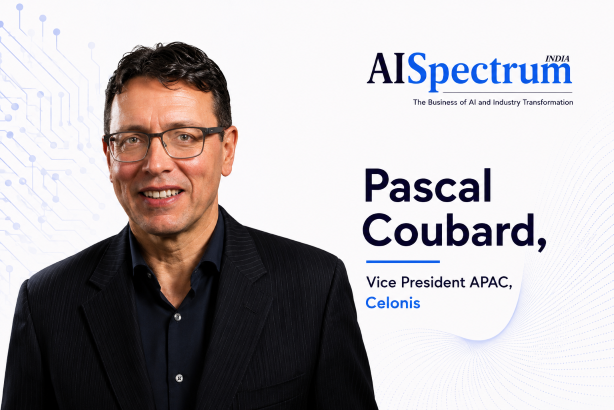
In this interaction with AI Spectrum, Pascal Coubard, Vice President APAC, Celonis, discusses the strategic objectives behind the initiative, the role of digital twins in enabling Enterprise AI, integration with legacy systems, and potential AI use cases across PIL’s global shipping network. He also shares his perspective on building trustworthy AI through human oversight and how process intelligence could enable the transition towards agentic and increasingly autonomous operations in global shipping over the next three to five years.
What strategic business challenges is this initiative designed to address, and how do you expect it to reshape operations across your global shipping network?
Global shipping is inherently complex, spanning multiple geographies, diverse agency networks, and highly fragmented front and back-office operations. For a longstanding institution such as PIL, operating such a large fleet, achieving clear end-to-end operational visibility is a critical challenge.
By expanding its global Process Intelligence Centre of Excellence (CoE) alongside Celonis and WNS, PIL is addressing these challenges head-on. The initiative establishes a single, continuous standard for how operations run globally. It harmonises and optimises workflows across trade operations, customer service, and shared back-office functions. Reshaping operations at this scale provides PIL with the agility to eliminate operational friction, speed up decision-making, and continuously deliver leaner, more resilient global shipping services.
How does Celonis’ Platform and digital twin improve the effectiveness of Enterprise AI compared to conventional analytics and automation tools?
Conventional analytics tell you what happened in the past, and traditional automation tools execute isolated tasks without knowing why or how those tasks impact the broader ecosystem. Enterprise AI models fail when they lack operational context because they simply do not understand how an organisation actually runs.
The Celonis Platform solves this via the Celonis Context Model which creates a real-time, dynamic digital twin of enterprise operations. By combining raw process data from across PIL’s disparate systems with institutional business knowledge and AI-driven intelligence, Celonis acts as the "context layer". It grounds Enterprise AI in the ground-truth reality of business operations, giving AI models the hindsight, insight, and foresight required to reason accurately, predict outcomes, and execute safe, high-impact decisions.
How does the Celonis platform integrate with diverse, legacy shipping systems without disrupting existing operations?
Maritime and logistics supply chains rely heavily on legacy software, custom systems, and commercial off-the-shelf (COTS) applications distributed across multiple oceans and continents. Replacing these core operational engines is rarely feasible and often causes severe business disruption.
Celonis integrates seamlessly without requiring organisations to "rip and replace" existing technology. Beyond robust native connectors for legacy software, Celonis leverages modern delta-sharing and zero-copy data architecture alongside modern platforms such as Databricks and Microsoft Fabric. This enables Celonis to securely extract and process high-frequency log data in real time with zero risk to operational stability, establishing a unified view of processes while leaving critical systems of record completely intact.
Could you share specific use cases where AI is expected to enhance operational efficiency, customer service, predictive decision-making, or supply chain resilience at PIL?
Because the CoE addresses the full operational spectrum - from front-office customer engagement to back-office financial and logistics execution - the opportunities for value creation are vast.
High-priority areas for process intelligence and AI-driven automation include optimising order-to-cash workflows, streamlining free-text purchase requisitions in procurement, proactively resolving demurrage and billing blocks, and improving global container visibility to avoid shipping delays. As the CoE program matures and scales across PIL's 90-country network, we look forward to sharing detailed metrics, specific use cases, and operational milestones.
How do you ensure that AI-driven recommendations remain transparent, trustworthy, and aligned with human oversight in mission-critical workflows?
In mission-critical global trade, "black box" AI is non-viable. Trust requires complete transparency, governance, and traceability. The Celonis Platform provides end-to-end process visibility, precise action flows, and intelligent orchestration to ensure all AI-driven insights and agentic actions operate within predefined business rules and guardrails.
Crucially, Celonis is designed with Human-in-the-Loop (HITL) controls at its core. In complex or high-risk decision points such as credit exception approvals or major routing adjustments, the platform presents fully traceable, data-backed recommendations to human operators, who retain final approval. This hybrid approach ensures AI accelerates human capability rather than operating blindly, delivering speed without sacrificing governance.
How do you see Process Intelligence evolving alongside generative AI and agentic AI, and what role will these technologies play in shaping global shipping over the next 3 to 5 years?
Over the next three to five years, global shipping will transition from static process automation to autonomous, multi-agent operational orchestration. However, autonomous agents are only as smart as the context they are fed. Without a deep understanding of process relationships, business rules, and operational constraints, autonomous AI risks executing the wrong actions at machine speed.
Process Intelligence will serve as the indispensable operational context layer that powers agentic AI. It provides autonomous agents with the tools, situational awareness, and boundary conditions required to navigate corporate systems safely. In global shipping, this means AI agents will soon be able to dynamically re-route cargo around disruptions, automate exception management across international borders, and optimise resource allocation in real time, enabling supply chains that are self-healing, highly resilient, and responsive to rapid global change.