

Artificial intelligence is increasingly moving beyond software and digital applications to become an intelligence layer for the physical world, transforming how organisations monitor assets, anticipate risks and make real-time decisions. The convergence of AI, Digital Twins, simulation, sensor fusion and operational data is creating new opportunities across defence, critical infrastructure, energy, ports, logistics and manufacturing.
OptiValue Tek is positioning itself at this intersection, with a focus on AI-driven intelligence, Digital Twins, defence technology and intelligent critical infrastructure. Its Intelligent Counter-UAV Defence Systems (ICUDS) platform brings together AI and multi-sensor inputs to support the counter-UAV intelligence cycle, while its Digital Twin capabilities are aimed at applications ranging from defence mission rehearsal to infrastructure stress testing and resilience planning.
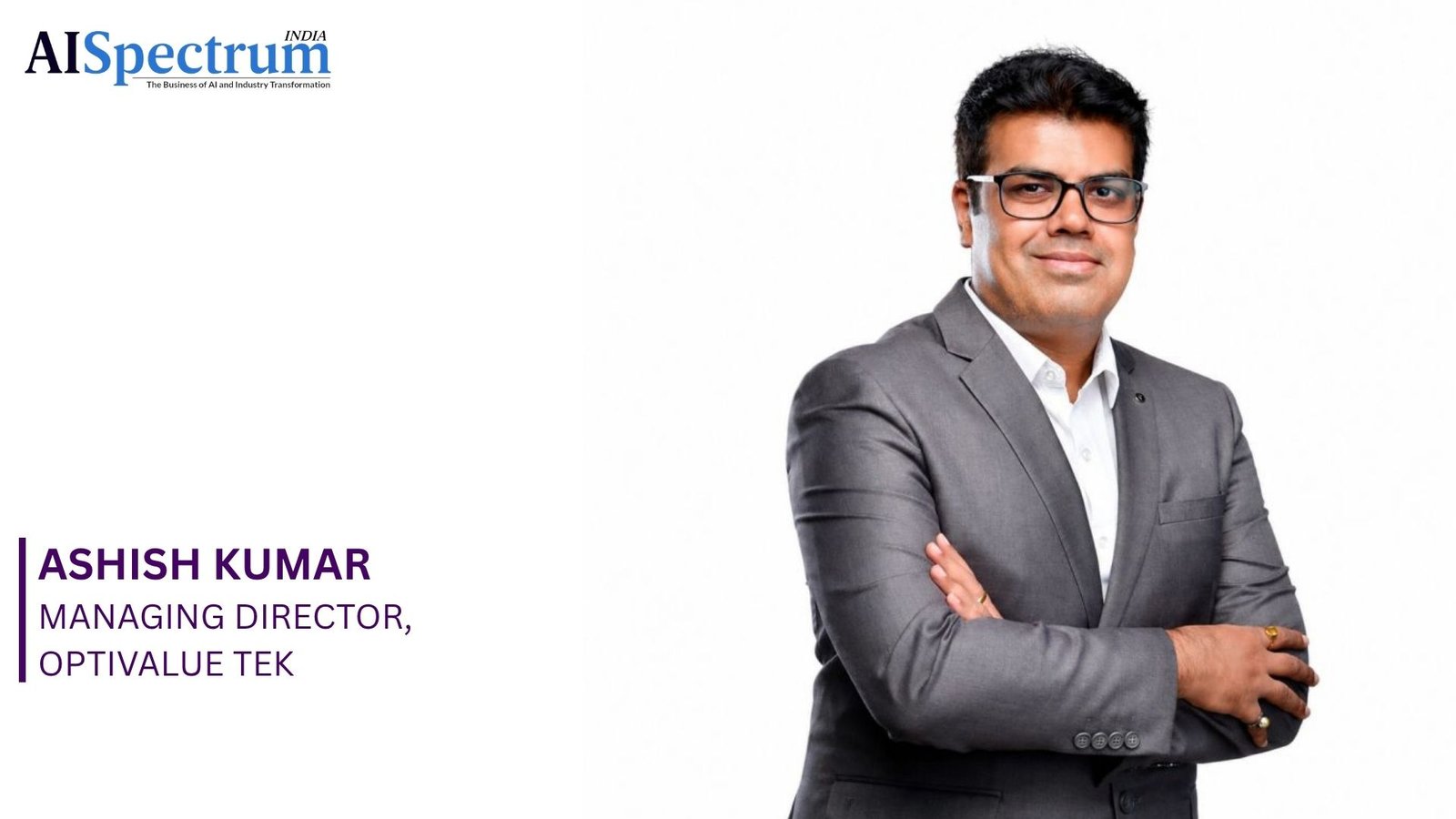
In this interview with AI Spectrum, Ashish Kumar, Managing Director, OptiValue Tek, discusses the company’s strategic focus on intelligent transformation, the role of AI in evolving counter-UAV systems, and the potential of AI-powered Digital Twins and simulation to enable predictive and context-aware decision-making. He also shares insights into OptiValue Tek’s defence technology roadmap, partnerships, international expansion and its vision for strengthening India’s capabilities in intelligent technologies for the physical world.
OptiValue Tek is sharpening its focus on AI, Digital Twins, defence technology, and intelligent critical infrastructure. What market trends and customer requirements are driving this strategic shift, and where do you see the strongest growth opportunities?
The market is moving from digital transformation to what we would call intelligent transformation. Customers are no longer looking only for technology that digitises processes; they want systems that can understand situations, anticipate risks and support better decisions. This shift is particularly visible in defence and critical infrastructure, where the cost of delayed decisions can be high. We are seeing increasing demand for AI-led intelligence, simulation, Digital Twins, autonomous systems and technologies that improve operational resilience.
For OptiValue Tek, the strongest opportunity lies at the intersection of the physical and digital worlds. Defence, energy, ports, logistics, manufacturing and smart infrastructure are all becoming increasingly data-driven and interconnected. Our focus is to help organisations move from simply monitoring assets to making them more predictable, intelligent and resilient.
The company has launched ICUDS (Intelligent Counter-UAV Defence Systems). Could you elaborate on the platform’s AI capabilities across detection, identification, tracking, classification, assessment, prediction, and response, and how it addresses evolving counter-UAV requirements?
ICUDS is built around a simple idea: the objective should not just be to detect a drone, but to understand the threat before it becomes an incident. The platform uses AI-driven analysis and multi-sensor inputs to support the complete counter-UAV intelligence cycle—from detection and identification to tracking, classification, threat assessment, and prediction. It brings together inputs such as RF intelligence, acoustic detection, and electro-optical surveillance to create a more comprehensive picture of the airspace. This is increasingly important because the threat landscape is evolving. Drones are becoming more autonomous, smaller, more difficult to detect, and capable of operating with reduced or no conventional RF signatures.
ICUDS is therefore designed as an intelligence-led, multi-layered counter-UAV platform, helping operators move from simply seeing an aerial object to understanding its behaviour, assessing its potential threat and supporting an appropriate response.
OptiValue has received a multi-million-dollar government order through GeM. What does this order signify for the company’s defence technology business, and how do you plan to scale ICUDS and related capabilities for defence and critical infrastructure applications?
The multi-million-dollar government order through GeM is an important validation of our capabilities and our ability to participate in India’s mission-critical technology ecosystem. More importantly, it demonstrates the growing opportunity for indigenous technology in defence and national security. We see this as a foundation for scaling our defence technology business rather than simply a standalone commercial milestone.
Our roadmap involves continued investment in AI, sensor fusion, simulation, product engineering and system integration. We also see opportunities to extend these capabilities beyond traditional defence applications into strategic facilities, ports, energy assets and other critical infrastructure. With ICUDS, our objective is to build a technology platform that can evolve alongside the threat landscape. The larger opportunity is to develop Indian-built, intelligent security capabilities that can be deployed across multiple operational environments.
Digital Twins are increasingly moving beyond traditional engineering and asset management. How is OptiValue using AI, simulation, and Digital Twins for applications such as defence mission rehearsal, infrastructure stress testing, and resilience planning?
The next generation of Digital Twins will go far beyond being digital replicas or visual dashboards. We believe they will increasingly become decision and simulation environments. By combining Digital Twins with AI and simulation, organisations can test different scenarios before taking action in the physical world. In defence, this can enable mission rehearsal, allowing teams to evaluate different scenarios, responses and constraints in a controlled environment.
For critical infrastructure, Digital Twins can be used to understand how systems could behave under stress. For example, organisations can simulate equipment failures, demand surges, supply-chain disruptions or multiple events occurring simultaneously. The real transformation is the shift from asking “What is happening?” to “What could happen next, and how should we respond?” That is where we see the strategic value of AI-powered Digital Twins.
The company describes its technology stack as an “intelligence layer for the physical world.” How do you see the convergence of AI, Digital Twins, simulation, and operational data transforming real-time decision-making across sectors such as defence, energy, ports, and logistics?
The physical world generates enormous amounts of data, but data alone does not equal intelligence. The real value emerges when AI can interpret that data, Digital Twins can provide context, and simulation can explore possible outcomes. That is what we mean by an “intelligence layer for the physical world.”Take a port, for example. Operational data can tell us where assets are and what is happening, while a Digital Twin can show how those assets and processes interact. AI can identify patterns or anomalies, while simulation can help assess what could happen if a critical asset fails or operations are disrupted.
The same principle applies to defence, energy and logistics. Technology can help organisations move from reactive decision-making towards context-aware and predictive operations.
Ultimately, we see the evolution from dashboards that explain what happened to intelligent systems that can help decision-makers understand what is happening, what may happen next, and what actions they can consider.
Looking ahead, what are OptiValue Tek’s priorities for the next phase of growth, particularly in terms of new AI and defence solutions, partnerships, international markets, and building India’s capabilities in intelligent critical infrastructure?
Our next phase of growth is about building deeper capabilities and converting them into scalable solutions. We will continue to invest in AI, Digital Twins, simulation, defence technology and intelligent critical infrastructure. Defence will remain a key focus, including the continued evolution of ICUDS and related technologies. At the same time, we see significant opportunities across energy, ports, logistics, manufacturing and other infrastructure-intensive sectors. Partnerships will also play an important role. The complexity of these technologies requires collaboration across engineering, AI, sensors, systems integration and domain expertise. We intend to build partnerships that can accelerate both innovation and deployment. International markets are another area we are actively looking at as demand increases for intelligent systems, resilience technologies and advanced security solutions.
Ultimately, our ambition is bigger than individual products. We want to contribute to an ecosystem where India develops, deploys and exports intelligent technologies for the physical world—moving from being primarily a technology consumer to becoming a technology creator with global relevance.