

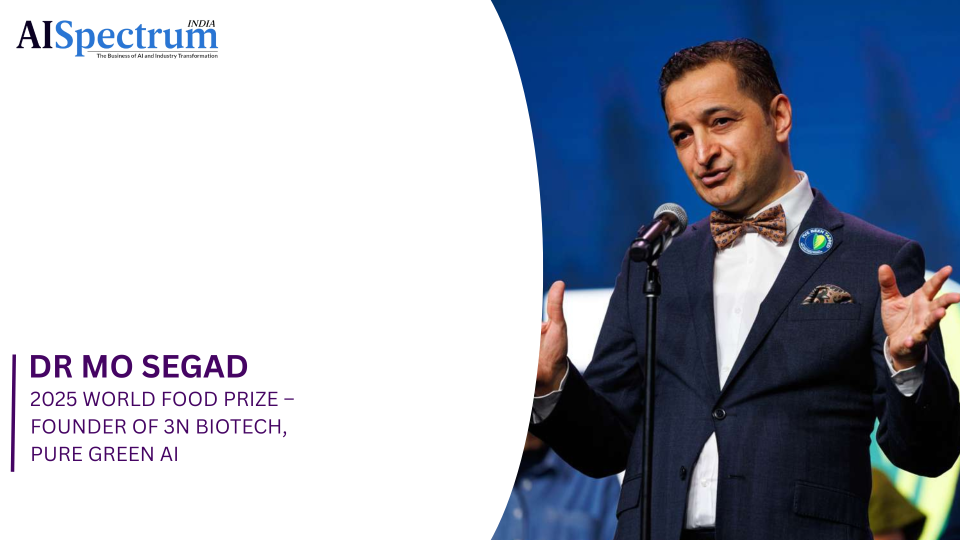
Dr Mo Segad, a Swedish and American soil scientist and inventor, was officially recognised by the World Food Prize Foundation as one of the 39 recipients in the 2025 Top Agri-Food Pioneers (TAP) cohort. He is a distinguished professor, UNCCD-accredited expert, and globally recognised inventor whose work is redefining climate-smart and resilient desert agriculture. As founder of 3N BioTech, Pure Green AI, and a UN-accredited forestry organisation, and as a distinguished council member of the World Agriculture Forum, Dr Segad integrates AI, soil science, and regenerative practices to deliver scalable, verifiable solutions aligned with COP outcomes, NDCs, UNCCD Land Degradation Neutrality, and FAO food security mandates. In an interview with AI Spectrum and AgroSpectrum, he highlights how pioneering nano/bio soil technologies and nature-based innovations are transforming arid and degraded lands into productive, climate-resilient farms that boost food security while reducing water use, agrochemicals, and carbon emissions and use of technology such as AI in maintaining soil health. Edited excerpts;
As a 2025 World Food Prize – Top Agri-Food Pioneer, how does your innovative work directly support agricultural and sustainable practices to boost national and global food security?
Standing on the World Food Prize stage was a profound honour, yet a clear reminder that awards are not the measure of our work; impact is. My mission is to treat nature with nature so farmers, local communities, and Indigenous peoples can grow more organic food with less water and no agrochemicals, while restoring drylands/soils and reducing carbon emissions. From first-generation, custom-made Liquid Clays to next-generation, custom-formulated 3N BioTech, I have focused on innovative eco-engineering that delivers cost-effective, scalable, nature-based technologies to transform arid and semi-arid lands, combat water scarcity, and tackle soil salinisation in a time of climate crisis.
By transforming sandy and degraded soils into living, productive lands, we can increase yields while cutting irrigation and fertiliser use, reverse desertification, and enhance soil carbon. This enables countries to expand climate-resilient organic farming without encroaching on high-biodiversity or high-emissions frontiers.
Recognition such as “Innovator of the Future” further encourages me to continue promoting credible innovation that aligns directly with COP outcomes and national commitments, advancing NDCs (emissions reductions via soil carbon and input efficiency), NAPs (adaptation through drought-resilient agriculture), UNCCD Land Degradation Neutrality, and the SDGs / CGIAR / ICARDA priorities. In short, innovation and science-led soil solutions are not an adjunct to food security; they are its foundation.
How can climate-resilient desert agriculture be promoted and scaled further?
We must reposition innovative desert agriculture as a core adaptation, not a niche. The fastest path to scale is to treat nature with nature by deploying innovative, cost-effective, custom-made, nature-based soil and water technologies with verifiable outcomes. When arid and semi-arid lands become productive without depleting freshwater or aquifers and without expanding emissions, adaptation and food security advance together.
To get there, countries should embed desert agriculture in national adaptation plans and food security strategies with clear targets to implement and deploy innovation, so that millions of hectares can be restored, water saved, salinity reduced, and farmer incomes stabilised. After decades of heavy mechanisation and agrochemical intensity, it is time to pivot to innovative, custom-formulated desert Ag solutions paired with outcome-based incentives. AI-enabled agronomy can further accelerate impact i.e. integrating AI with nature-based technologies to optimise irrigation and risk management for both smallholders and large estates.
In sum: innovative nature-based AgTech, policy alignment, local production, outcome incentives, AI-enabled advisory, and catalytic finance—this is how we make desert agriculture and drylands a pillar of adaptation at national and continental scale.
What is a climate solution that isn’t getting the attention or funding it deserves?
Salinity reversal in drylands, along with sand-to-productive-farm transformation, is an underfunded powerhouse. Salinisation silently removes millions of hectares from production. This is why I have invented and developed custom-formulated, nature-based Ag-solutions to enhance soil structure, improve water-holding capacity, and restore biological function, addressing salinity and barren lands at their roots.
Integrated with regenerative practices (no-tillage, ground cover, and salt-tolerant rotations), these solutions rapidly restore farm productivity, save water, reduce agrochemical dependency, and unlock resilient yields—while reversing desertification and increasing soil carbon. Because these benefits cut across adaptation, mitigation, livelihoods, and water security, salinity reversal and sand-to-soil solutions deserve a central place in UNCCD Land Degradation Neutrality portfolios and climate-finance windows.
How do you see integrating soil nano/biotechnology and water-retention strategies into national food security programmes while reducing dependency on unsustainable irrigation systems?
Adopt and accelerate science-backed innovations and proven emerging technologies that scale what works by setting national performance standards for minimum water savings, salinity reduction, and soil organic carbon gains while keeping technology pathways open to spur innovation. Prioritise arid and semi-arid regions and saline soils, where returns on water and soil interventions are highest, and integrate custom-made nano- and bio-AgTech with drip and sensor-guided irrigation to reduce demand and stabilise yields. Practice aquifer stewardship by linking on-farm water savings to basin-level caps, recharge programmes, and equitable allocation frameworks so that efficiency gains translate into aquifer recovery rather than rebound extraction. This approach embeds high-integrity soil and water outcomes into national food security strategies, reduces dependence on unsustainable irrigation, and builds resilience where it is needed most.
At recent COP and FAO forums, fertiliser sustainability has emerged as both a climate and geopolitical issue. How do nano-based and bio-enabled fertiliser systems contribute to reducing emissions, improving efficiency, and strengthening fertiliser security for importing nations?
Recently, I was globally recognised by the World Food Prize Foundation for two decades of pioneering work in soil nanotechnology. Treating nature with nature is central to our transition pathway. Nano- and bio-enabled systems deliver nutrients more precisely and rebuild soil function—while reducing costs and risk.
Importantly, nano-fertilisers and nano-formulations synchronise nutrient release with plant demand and root uptake, cutting runoff, leaching, and GHG emissions from over-application. Demand is rising for organic nano-fertilisers compatible with regenerative agriculture, and for bio-enabled inputs (microbial consortia, biostimulants) that offer soil-health co-benefits while reducing embedded emissions from production and long-haul transport.
Bottom line: this is more than “greener fertiliser.” It is a resilience strategy that aligns food security, climate targets, farm profitability, and national sovereignty over critical inputs, accelerating the transition to climate-smart, soil-healthy, and supply-secure agriculture.
As soil carbon sequestration gains traction in voluntary and compliance markets, what safeguards, measurement standards, and governance are needed to ensure integrity, prevent greenwashing, and protect smallholders—and what financing mechanisms can rapidly scale land restoration and climate-smart agriculture?
My approach is simple: innovation, foresight, transparency, and accountability ... or nothing. That’s why we’re launching Pure Green AI: a human-in-the-loop, blockchain-powered foresight, peer-review, and validation platform that predicts environmental risks, verifies soil and ecosystem outcomes, and eliminates greenwashing by anchoring projects to globally recognised standards.
Pure Green AI combines predictive, standardised AI tools with immutable audit trails to guide science-backed interventions across soil carbon, climate-smart farming, mangrove, forestry, and biodiversity projects. With tokenised, results-based finance, we unlock funding only after verified impact, scaling innovative, nature-based solutions with integrity; transforming degraded soils into fertile farmland; accelerating transparent eco-restoration; and building resilient landscapes and smart cities.
In short: Blended and green finance should fund scale-up, de-risking early adoption, expanding local production capacity, and financing tree-planting and eco-restoration projects that recharge water cycles and build climate resilience. Pure Green AI is a credible end-to-end operating system and smart oracle for measurable, financeable, and fraud-resistant eco-restoration—where projects, people, and nature thrive together.