
Artificial intelligence and robotics are increasingly moving beyond conventional automation, enabling new models of autonomous operations across industries where consistency, scalability and labour availability are critical. In food service, the convergence of AI, robotics, software and intelligent supply chains is creating opportunities to automate not only food preparation but also inventory management, demand forecasting and operational decision-making.
Circus is developing an autonomous food-production ecosystem that brings these capabilities together through its robotic systems, CircusOS software platform and Circus Pods. The Pods provide a standardised ingredient infrastructure, while AI-driven systems use real-time consumption and operational data to optimise inventory, demand and fleet performance. The approach is being applied across commercial and defence environments, including deployments involving the German Armed Forces.
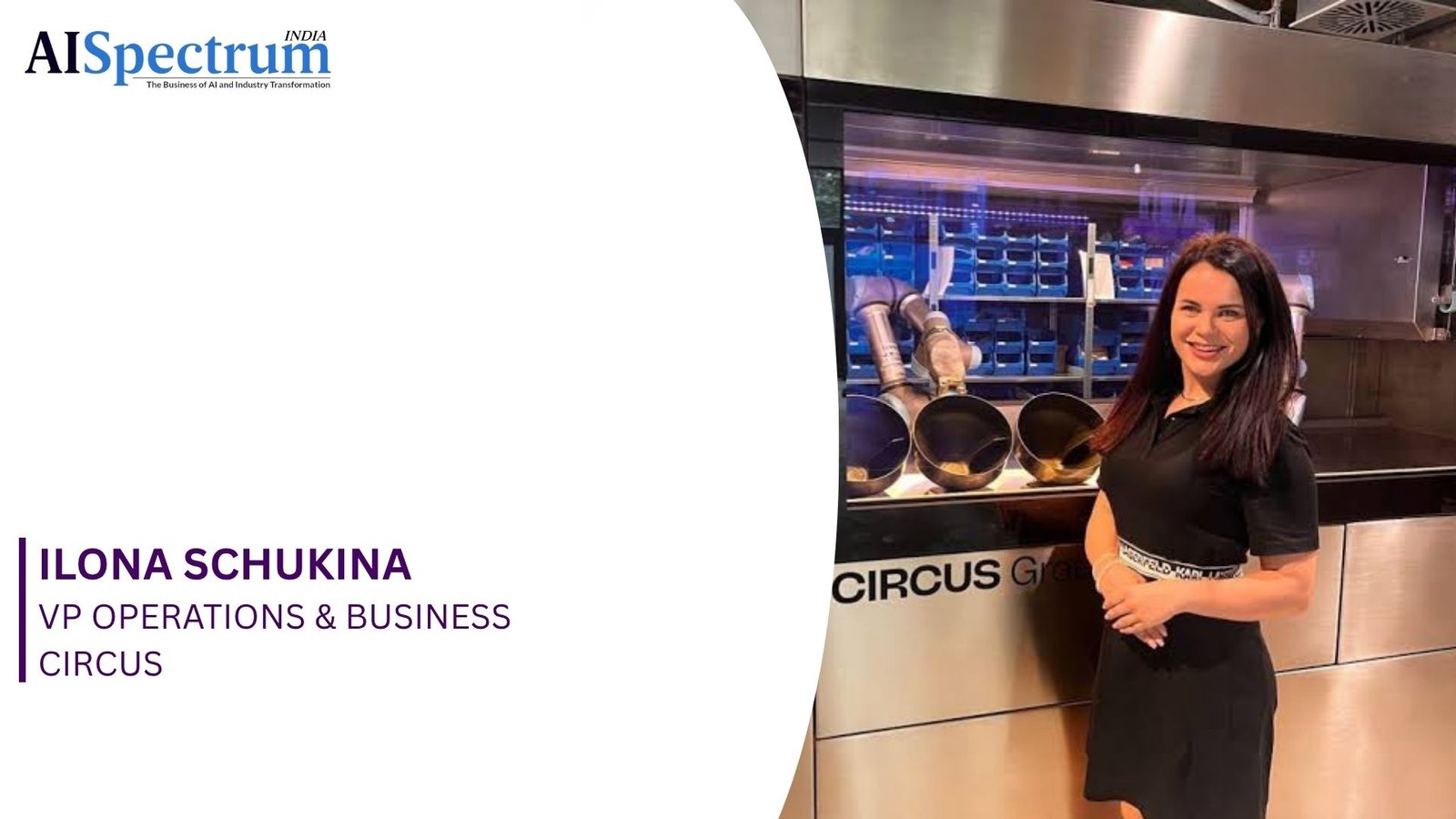
In this interview with AI Spectrum, Ilona Schukina, VP Operations & Business Development at Circus, discusses the operational challenges of scaling autonomous food production across multiple markets, the role of AI in creating a real-time supply chain, and how CircusOS and Pods form a closed-loop ecosystem connecting software, robotics and food supply. She also shares insights into automation-driven efficiency, the technology’s application across commercial and defence environments, and Circus’ vision for the future of AI-powered autonomous food production.
What were the key challenges in integrating ingredient supply and food preparation with Circus' autonomous robotic systems, and how do Circus Pods address these challenges?
Ilona Schukina: "Before Pods, the hardest operating challenge wasn't robotics. It was the last mile of ingredient logistics feeding the robot. I run operations across seven markets with very different supply chains, from REWE retail sites in Germany to defense deployments in Ukraine, and the failure mode was always the same: non-standardized ingredient formats meant every new site was effectively a bespoke sourcing project. That doesn't scale, and it's invisible to people outside operations until it breaks a rollout. Circus Pods solve this by giving every robot in the fleet (commercial or defense) a single standardized ingredient and supply chain infrastructure. Once every dish is executed on a Pod, we've converted what used to be a market-by-market operational risk into a repeatable, auditable input."
How does the AI-driven supply chain use data from scanned Pods to optimize ingredient management, robot operations, and overall system performance in real time?
Ilona Schukina: "Every Pod scan feeds our AI models in real time, which means I'm not managing inventory on a lag anymore. I'm managing it on a live feed across the fleet. Operationally, that changes the job: instead of reactive restocking calls, my team is tuning par levels and demand curves off actual consumption data per site, per SKU, updated continuously. For a multi-country operation like ours, where I'm balancing customs timelines against retail velocity against defense supply cadence, that real-time visibility is what makes central coordination possible at all."
How does the integration of Circus Pods with CircusOS create a closed-loop ecosystem connecting AI, robotics, software, and ingredient supply?
Ilona Schukina: "CircusOS is the control layer that optimizes operations, predicts demand, and adapts menus automatically, but a control system is only as good as the data quality coming in. Pods are what make that data trustworthy: standardized format, scanned at point of use, so the AI is learning from clean signal rather than reconciling messy manual logs. It's not robotics plus software as two separate things. It's a single system where the ingredient layer, the AI, and the hardware compound each other's value. From where I sit operationally, that's also what de-risks scaling: I'm not adding operational headcount linearly with fleet size."
Circus states that Pod scanning can reduce manual preparation and daily operator handling by approximately 80%. What role do AI and automation play in achieving this reduction, and what other operational efficiencies have you observed during field testing?
Ilona Schukina: "I'd separate the 80% reduction into two distinct gains. First, direct labor substitution, Pods replace manual sourcing of multiple ingredients, preparation of each SKU, best-before management and waste handling. Second, and less obvious: it removes variance. Manual handling is where quality drift and human mistakes cause issues across a distributed fleet. Standardizing that step is what let us take the ingredient model live across seven markets with over 30 ingredients without a proportional increase in field operations support. That second effect, variance reduction, is the part that shows up in uptime, not just headcount."
With Circus Pods being deployed across commercial and defense applications, including the German Armed Forces, how does the technology adapt to different operating environments and requirements?
Ilona Schukina: "I think this is the most underappreciated proof point in the story. Circus Pods were field-tested with customers including the German Armed Forces before becoming mandatory across all operating systems, and what that tells you operationally is that the same ingredient and software architecture holds up whether the constraint is retail foot traffic in Germany or 24/7 unattended supply in a conflict zone. The variable that changes is the hardware envelope and deployment logistics, not the ingredient standard or the AI layer. Having run both commercial retail rollouts and cross-border shipments into active operating environments, I can say that consistency is deliberate architecture, not luck. It's what lets a defense contract and a supermarket contract sit on the same underlying platform economics."
Looking ahead, how does Circus plan to evolve its AI and autonomous food-production platform, and what opportunities do you see for AI-powered robotics in large-scale food service, defense, and other high-demand environments?
Ilona Schukina: "Pods are produced by specialized food-production partners to our specifications and distributed through a global supply chain, while Circus owns and coordinates the platform. That gives us the control of vertical integration without the capital intensity: we define the standard, partners carry production and logistics. Layered onto the recurring software revenue through CircusOS, every deployed system builds two compounding revenue streams instead of one hardware sale. And we are not standing still: we keep expanding the ingredient range, keep testing new product lines, and continue the rollout across all deployments through the second half of this year. Looking forward, I expect the next phase of proof points to come from exactly the environments I operate in every day: multi-country retail, institutional catering, defense and disaster-relief logistics. Anywhere the constraint is consistent output regardless of available labor. That's not a niche use case."