

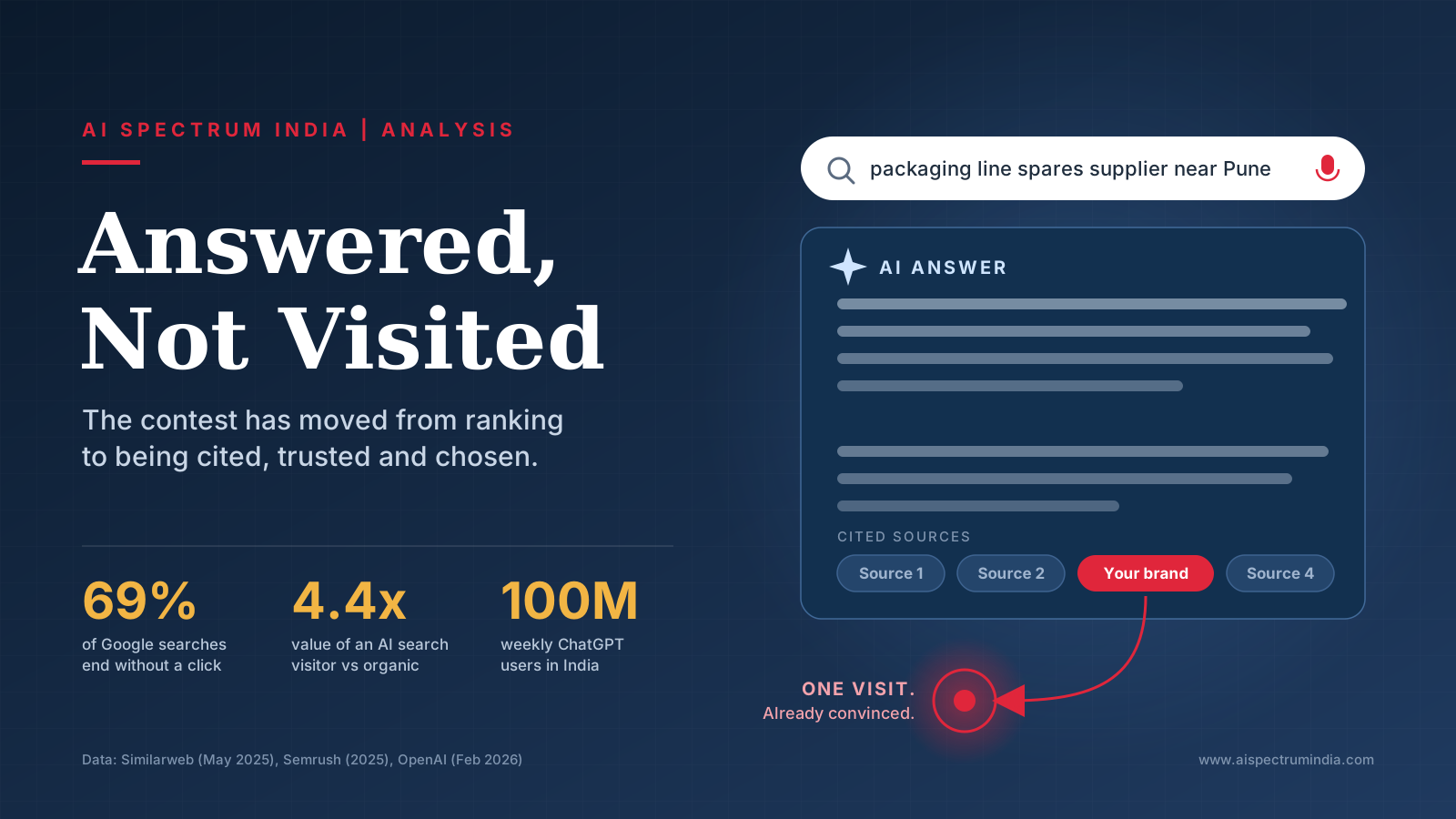
Picture a plant manager in Chakan, outside Pune, standing next to a packaging line that keeps jamming. A few years ago she would have typed a clumsy query into Google, opened four supplier websites in separate tabs and called the one whose page looked most credible. Today she points her phone camera at the faulty part, asks a question in Marathi, and gets a synthesised answer that names the likely fault, suggests two fixes and mentions a couple of suppliers. She may never visit a single website. If she does, it will be one, and she will arrive already half convinced.
That small scene, repeated hundreds of millions of times a day, is the most important change in digital marketing since the smartphone. Search has not died. It has been absorbed. The answer now lives on the results page or inside a chat window, and the website has been demoted from destination to source material.
For Indian businesses that spent a decade learning to rank, this demands a different question. Not "how do we get more traffic?" but "when an AI system explains our category to a buyer, do we appear, are we described accurately, and are we the one they choose to contact?"
The click is becoming the exception
The data on this shift has moved from anecdote to pattern.
Similarweb found that the share of Google searches ending without a click rose from 56% in May 2024 to 69% a year later. For news sites, Google referrals fell from about 2.4 billion visits to roughly 1.8 billion over the same period, a drop of about a quarter. Traffic from ChatGPT grew sharply but replaced only around 25 million of the roughly 600 million lost visits.
Pew Research Center reached a similar conclusion by watching what people actually did. Tracking the browsing of 900 US adults across nearly 69,000 Google searches in early 2025, it found that users clicked a traditional result in 8% of visits when an AI summary appeared, against 15% when none did. Clicks on links inside the summary itself occurred in only 1% of visits. People who saw a summary were also more likely to simply stop browsing.
Bain and Company, surveying consumer behaviour in early 2025, reported that about 80% of search users rely on AI summaries for at least 40% of their searches, and that roughly 60% of searches now end without the user going on to another destination.
Google disputes some of these methods and argues that AI features send traffic to a wider range of sites. Fair enough. But every independent lens points the same way: the click, once the default outcome of a search, is fast becoming the exception.
|
BY THE NUMBERS |
|
|
69% |
of Google searches ended without a click in May 2025, up from 56% a year earlier (Similarweb) |
|
25% |
fall in Google referrals to news websites over the same year (Similarweb) |
|
1% |
of visits with an AI summary produced a click on a cited source (Pew Research Center) |
|
80% |
of search users rely on AI summaries for at least 40% of their searches (Bain) |
|
4.4x |
estimated value of an AI search visitor versus a traditional organic visitor (Semrush) |
|
100 million |
weekly ChatGPT users in India, its second-largest market (OpenAI, Feb 2026) |
|
30%+ |
of leading Indian news publishers blocking OpenAI crawlers (DNPA, via exchange4media) |
Sources as noted. Figures from vendor studies should be read as directional.
Why India is ahead of the curve, not behind it
Indian marketers are used to watching search trends arrive from the US a year or two late. This time the gap has largely vanished, and in some respects India is leading.
Google opened AI Mode to Indian users through Search Labs in June 2025, extended it to everyone in the country in July, added Hindi in September and, in October 2025, made India only the second market after the US to receive Search Live, its camera and voice conversational search, along with seven more Indian languages. Google has described Indian users as its largest base anywhere for voice and visual search.
The chatbots have scaled just as quickly. OpenAI chief executive Sam Altman said in February 2026 that ChatGPT had 100 million weekly active users in India, making it the second-largest market after the US, with more student users than any other country. A ChatGPT Go plan priced for India, and later offered free for a year, has only deepened the habit.
Three features of the Indian market amplify the shift.
The first is modality. Voice and camera queries are answer-seeking by nature. Nobody photographs a diseased cotton leaf or a blister pack hoping for a list of links. They want a verdict.
The second is language. When an answer engine responds in Hindi, Tamil or Bengali, it cites whatever trustworthy material exists in that language. A brand whose regional content is thin, machine-translated or missing is not merely ranked lower. It simply does not exist in the answer.
The third is the way Indian commerce closes. A large share of B2B and small business transactions conclude on a phone call or a WhatsApp chat, not on a web form. When discovery happens inside an AI answer and the deal closes in a WhatsApp thread, standard analytics sees neither event. Indian marketers are therefore at risk of losing the measurement argument even when they are winning the market.
The new economics: fewer visits, heavier visits
If AI search only destroyed traffic, the strategic response would be simple: diversify away from search. The reality is more interesting, because the visits that survive appear to be worth considerably more.
Ahrefs published its own figures in mid-2025. AI search accounted for just 0.5% of visitors to its site but 12.1% of signups, implying a conversion rate around 23 times higher than traditional organic search. Semrush, studying a broader set of sites, estimated that the average visitor arriving from an AI source is worth about 4.4 times a traditional organic visitor, and projected that AI channels could match traditional search in economic value by the end of 2027. Both companies sell search tools and both cautioned that the gap may narrow as volumes grow, so treat the exact multiples with care. The direction, however, is consistent.
The mechanism is easy to understand. Call it intent compression. The research a buyer once did by opening ten tabs now happens inside the AI conversation. By the time someone clicks through, the browsing, comparing and shortlisting are done. What remains is the decision.
That changes what a marketing dashboard should celebrate. A falling sessions line can sit alongside steady or rising enquiries, because the lost visits were the definition seekers and casual browsers who rarely bought anything. Some of that lost traffic was costing money in hosting, analytics and bandwidth without returning any.
But it would be a mistake to treat the shrinkage as costless. For publishers, reach is the product. For brands, today's casual reader is often next year's buyer, and an AI answer that explains the category without naming you does nothing for future demand. The honest position is that AI search improves the quality of the visit while threatening the breadth of the brand. Leaders need to manage both at once.
Three myths worth retiring
Boardroom conversations about AI search tend to stall on a few assumptions that no longer hold.
The first myth is that falling traffic means falling performance. Sessions were a convenient proxy for value when traffic and revenue moved together. That link has weakened. A business can lose a third of its visits and gain enquiries, or grow traffic while its pipeline stalls because the new visitors only wanted a definition. Traffic still describes reach, but it can no longer stand in for commercial results.
The second myth is that AI visibility is a separate channel that needs a separate team and a separate budget. In practice, the material AI systems cite is the same material that performs well in conventional search: well-structured, accurate, original and authoritative content on technically sound pages. Treating AI visibility as an extension of search, with its own defined slice of investment, is more effective than treating it as a replacement.
The third myth is that more content will win the answer. When producing an article costs almost nothing, volume stops being a differentiator. One page with proprietary data, a named expert and a clear comparison is more likely to be cited than fifty generic posts on the same topic. The winning question is no longer "how much can we publish?" but "what do we know that nobody else can say?"
Retiring these myths matters because each one leads to a predictable mistake: cutting a programme that is quietly working, building a disconnected AI team without fixing the foundations, or flooding the web with content that AI systems learn to ignore.
Three companies, three fates
The clearest way to see what determines the outcome is to look at businesses that have already been through it.
The diversified: HubSpot
HubSpot practically invented inbound marketing. Its blog grew to more than 13,000 articles and, at its 2022 peak, an estimated 24 million monthly organic visits. Between late 2024 and mid-2025, third-party tools recorded a fall in blog traffic of roughly three quarters.
The business barely flinched. Revenue continued to grow, and chief executive Yamini Rangan told investors in 2025 that only around a tenth of leads now came from blog traffic. The traffic that disappeared was concentrated in content far from HubSpot's core: quotation lists, letter templates and general explainers that AI can answer in a sentence. Material close to marketing, sales and CRM expertise held up far better. HubSpot then restructured its content for AI citation, rebuilt its funnel around discovery inside assistants and started selling answer engine optimisation tools to customers.
The lesson: when the traffic you lose was never commercial, a dramatic chart can hide a healthy business.
The disintermediated: Chegg
Chegg, the US homework help company, faced the opposite situation. Its product was the answer. In February 2025, it sued Google, alleging that AI Overviews used content from sites like its own to keep students on Google. It reported that non-subscriber traffic had fallen 49% year on year in January 2025, compared with an 8% decline in mid-2024, and said it was exploring strategic alternatives, including a sale. Google said it would contest the claims.
The lesson is blunt. If what you sell can be summarised, AI does not shorten your funnel. It removes it.
The distributed: India's news brands
The Indian news market offers the most revealing comparison, because many brands faced the same algorithms with very different results. Press Gazette and Similarweb data for April 2026, reported by exchange4media, showed year-on-year traffic declines of 50% at Hindustan Times, 33% at The Indian Express, 26% at News18 and 66% at India.com. Over the same period, NDTV.com grew 39% to roughly 200 million monthly visits. Its editors credited heavy investment in video, data-led explainers and a deliberate strategy of reaching audiences on the platforms where they already spend time.
Industry voices quoted in that coverage also pointed to a distinctly Indian factor: short-form video and regional-language apps have created a parallel discovery system that captures attention before it ever reaches a publisher's website.
The lesson: the algorithm sets the conditions, but format, distinctiveness and distribution decide who survives them.
Put the three cases side by side and a simple diagnostic emerges. Ask what kind of value your business delivers. If it is expertise that leads to a relationship, AI search can make you more efficient. If it is information that ends with the answer, AI search is an existential threat. If it is attention, you must follow the audience wherever it now gathers.
The bargaining front
There is a second contest running alongside the marketing one: who gets paid when content becomes the raw material for AI answers.
According to the Digital News Publishers Association, more than 30% of leading Indian news publishers had blocked OpenAI's crawlers by mid-2026, as exchange4media reported in June. News agency ANI's copyright case against OpenAI in the Delhi High Court is still awaiting a verdict, with OpenAI denying wrongdoing. Pradeep Gairola of The Hindu framed the publishers' fear sharply, arguing that "scarcity is being manufactured" by AI, and noted that licensing deals offered in other markets have not yet arrived in India at comparable scale.
The dilemma is real. Publishers say there is no selective way to stay out of AI Overviews without also disappearing from ordinary search results. Blocking a crawler protects content but can reduce visibility in the very answers that buyers now read.
For non-media businesses, the takeaway is practical rather than political. Decide deliberately which content you want AI systems to learn from and cite, typically product facts, specifications, pricing logic and expert explanations, and which content you want to keep behind a login or a relationship. Visibility and protection are now a strategic choice, not a default setting.
What makes a brand citable
The industry has coined several labels for the new discipline: generative engine optimisation, answer engine optimisation, AI visibility. The names matter less than the mechanics. An AI system can only cite what it can reach, parse, trust and connect to the question in front of it. That suggests five tests every important page should pass.
Is it reachable? A page that loads its content through heavy scripts, hides specifications in PDFs or blocks crawlers will be ignored. The unglamorous technical work of clean HTML, fast rendering and sensible site structure is now the entry ticket to AI visibility, not a competing priority. Teams tempted to cut technical budgets to buy AI monitoring dashboards risk paying to watch their own absence.
Is it current? AI systems lean toward fresh, dated information. A price list from 2023 or a discontinued product page left online can be quoted to a buyer as fact.
Is it specific? Vague marketing copy gives a model nothing to cite. Named products, exact capacities, certifications, delivery times, comparison tables and clearly stated trade-offs give it something concrete to repeat.
Is it corroborated? Models are more confident when independent sources agree. Industry coverage, analyst mentions, case studies with named customers and consistent listings across directories all strengthen the signal.
Is it commercial? Most brands have optimised their awareness content and neglected the questions buyers ask at the point of decision: what does this cost, how does it compare, how long does implementation take, who else uses it. If a brand does not answer those questions clearly, the AI will answer them using forum posts, old reviews or a competitor's page.
For Indian companies, add a sixth test: is it available in the languages your buyers actually use, written natively rather than machine-translated?
Measuring what you can no longer see
The hardest part of this transition is measurement. AI assistants pass little or no referral data, personalised answers differ from user to user, and a large share of AI-influenced visits show up in analytics as direct traffic. Industry tooling for tracking AI visibility is maturing but remains patchy.
The danger is not that marketers lack perfect data. It is that, without a credible record, search programmes that are still producing business get cut because they cannot prove it. A simple visibility ledger, maintained with discipline, is worth more than an expensive dashboard nobody trusts.
- Build a question bank. List 30 to 50 questions real buyers ask at each stage of the purchase, drawn from sales calls and support tickets, in English and the relevant Indian languages.
- Audit answers monthly. Run those questions through Google's AI features, ChatGPT, Gemini and Perplexity. Record whether your brand appears, how it is described and whether the facts are right.
- Ask every enquirer. Add a "where did you first hear about us?" field to forms, calls and WhatsApp conversations, with AI assistants listed as an explicit option.
- Tag every entry point. Use call tracking and tagged WhatsApp links so that conversations carry a source instead of disappearing into a direct bucket.
- Reconcile monthly. Match marketing-sourced enquiries against closed business in the CRM, and report qualified pipeline and revenue above sessions.
Every number in that ledger should carry a baseline and an honest confidence rating. Leaders can make sound decisions with imperfect data if they know which figures are solid and which are directional.
The content flood and the premium on judgment
Generative AI has also changed how content is made. Most marketing teams now use it for research, briefs and first drafts, and a growing number run multi-step workflows that generate, optimise and publish with limited human review.
The efficiency gains are real. So is the side effect. When average content becomes almost free to produce, the web fills with it, and AI systems trained to find reliable sources learn to discount anything that looks generic. The scarce assets become the ones a machine cannot manufacture: proprietary data, first-hand experience, named experts and the editorial judgment to decide what is true, useful and worth publishing.
That has implications for how Indian content teams are structured. The case is not for fewer people but for different work: fewer hours spent producing first drafts, more spent verifying facts, interviewing practitioners, building original datasets and owning the final decision on what carries the company's name. A team that combines AI speed with genuine editorial standards will be far harder to compete with than one that simply publishes more.
It also argues for deliberate training. Many Indian marketing and agency teams are young, and early-career staff are often focused on executing established tactics. Giving them a structured grounding in how AI systems retrieve, evaluate and cite information is one of the cheapest competitive advantages available today.
A sector lens for Indian business
The shift lands differently across the sectors AI Spectrum India follows.
Industrial and B2B manufacturing firms have the most to gain and the most to fix. Buyers ask detailed technical questions that AI answers well, but many supplier websites still bury specifications in brochures and offer no pricing logic. The firms that publish clear, structured technical content in English and regional languages can become the default citation for their niche.
Healthcare and pharmaceutical companies face an accuracy problem. An AI answer that misstates a dosage, an indication or an approval status is not merely bad marketing. Regular audits of how products are described in AI answers should sit with medical and regulatory teams, not only with marketing.
Fintech and financial services firms operate under strict disclosure rules. If AI systems summarise their products using outdated rates or terms, the reputational and compliance exposure is significant. Clear, dated, authoritative product pages are a risk control as much as a growth lever.
Edtech companies should study Chegg closely. Where the product is an answer, the business model needs to shift toward what AI cannot easily replicate: certification, community, mentorship and personalised progress.
Media owners are in the most complex position, simultaneously suppliers to AI systems, competitors with them and negotiating partners. Their path runs through direct audience relationships, video, events and licensing, with search treated as one channel among several rather than the foundation.
A 90-day plan for leadership teams
For CXOs and founders planning for 2027, the following sequence is practical without being expensive.
Days 1 to 30: find out where you stand
- Build the buyer question bank and run the first audit across the major AI tools.
- Map which pages actually produce enquiries and revenue, and which only produce traffic.
- Run a technical health check on your most commercially important pages.
- Agree the measures leadership will review, with pipeline and revenue at the top.
Days 31 to 60: fix the foundations
- Repair crawlability, rendering and outdated content on high-value pages first.
- Publish or rewrite bottom-of-funnel content: pricing logic, specifications, comparisons, case studies and implementation timelines.
- Add native-language versions of the content your most important buyers need.
- Switch on source capture across forms, calls and WhatsApp.
Days 61 to 90: test and decide
- Run two or three controlled experiments, such as an original data report, an expert-led comparison guide or a third-party coverage push.
- Repeat the AI answer audit and compare it with the baseline.
- Give each experiment a review date and clear criteria to scale or stop.
- Set a defined, bounded budget line for AI visibility within the overall search plan, without raiding the technical and content work it depends on.
Search is not disappearing. It is changing who gets the visit, why they come and what they expect when they arrive. The open web is shifting from a system that rewarded volume to one that rewards clarity, credibility and specificity.
That is uncomfortable for businesses that rented attention through high-volume content. It is an opportunity for those that own genuine expertise, original data and strong customer relationships. They may find that AI search sends them fewer visitors and better business.
India, with its voice-first, multilingual and mobile-native users, is one of the places where this future is arriving fastest. The companies that act now, measuring honestly, fixing their foundations and making themselves easy to cite, will shape how AI describes their categories for years to come. Understanding AI is a business advantage, not an option.
ABOUT THE RESEARCH
This analysis draws on independent behavioural research (Pew Research Center, Similarweb), consumer and industry studies (Bain and Company, Ahrefs, Semrush), company disclosures and published reporting, including exchange4media coverage of Indian publishers. Studies by search software vendors are cited as directional evidence. The opening scenario is illustrative.