

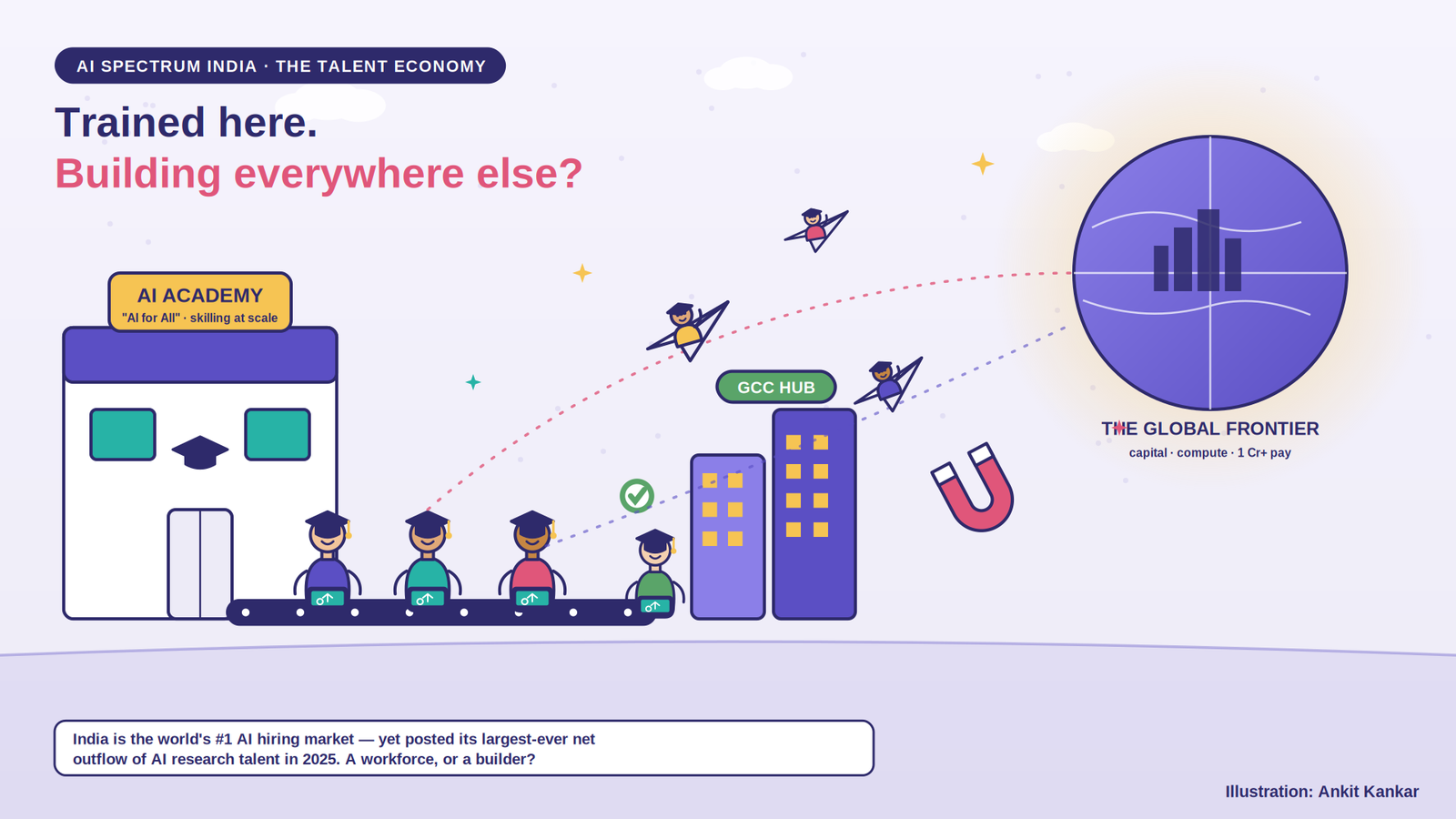
Two numbers, published weeks apart in early 2026, frame the whole story. The first: India is now the single largest market for AI hiring on the planet, with a global-capability-centre workforce of 2.36 million and the world’s second-deepest bench of AI researchers, behind only the United States. The second, from Stanford’s AI Index 2026: in 2025 India recorded the largest net outflow of AI research talent of any country — more of its top researchers left than came home. The nation that staffs the world’s AI ambitions is also the one steadily losing the people it can least afford to lose.
That is the central tension of India’s AI moment. Measured by volume, the country is already a superpower: it trains, certifies and employs AI professionals at a scale no rival except China can match. Measured by depth — the thin layer of people who design frontier systems rather than apply existing ones — it remains a net exporter. India has two faces in artificial intelligence, and which one defines the next decade depends on whether skilling, salaries and ecosystem depth can finally hold its best talent at home.
A skilling machine at population scale
The supply side of the story is genuinely formidable. India’s technology and AI ecosystem now employs more than six million people and generates revenues north of USD 280 billion a year. The skilled AI talent pool, on NASSCOM and Deloitte’s reckoning, is set to roughly double from around 650,000 in 2022 to more than 1.25 million by 2027, a compound growth rate near 15 per cent. AI hiring has expanded roughly eightfold since 2017. On most counts India accounts for well over a tenth of the global AI workforce.
The state has put its weight behind that pipeline. NITI Aayog’s National Strategy for Artificial Intelligence set the “AI for All” framing years ago; the IndiaAI Mission, approved in March 2024 with an outlay of about ₹10,300 crore (roughly USD 1.24 billion), turned ambition into budget lines. Its FutureSkills pillar funds 500 PhD fellows, 5,000 postgraduate and 8,000 undergraduate students, and by mid-2025 was already supporting more than 13,500 scholars, with dozens of institutes admitting candidates to new AI doctoral tracks. Data and AI labs are being seeded across Tier-2 and Tier-3 cities in partnership with NIELIT, and the Centres of Excellence in Bengaluru and Hyderabad anchor the research-and-industry interface. Lower down the pipeline, the SOAR programme is pushing AI literacy into school classrooms and the YuvAi initiative, run with AICTE, targets young professionals.
Industry runs a parallel machine. In a single year, Tata Consultancy Services trained some 350,000 employees and Wipro around 220,000 on AI and allied skills; global platforms have pledged AI training to millions more. The throughput is real, and it is why every projection shows India’s headline talent numbers climbing.
But scale is not the same as depth, and the supply figures carry an awkward asterisk: on at least one international benchmark India ranks well outside the top tier for measured AI-skill proficiency, even as its appetite for online courses leads the world. The country is producing AI workers in enormous numbers. Producing AI builders — the people who train base models and publish work others build on — is a different problem entirely.
The retention problem and the salary war
Demand is outrunning supply at every level of the market. A TeamLease Digital primer projects India’s AI talent gap reaching 53 per cent in 2026 — for every ten open generative-AI roles, the report estimates just one qualified engineer is available. ManpowerGroup’s 2026 survey found 82 per cent of Indian employers struggling to fill positions, well above the 72 per cent global average, with AI skills overtaking every other category as the hardest to find. Looking ahead, industry estimates put open AI-skilled roles at around 2.3 million by 2027 against a pool of 1.25 million — a shortfall comfortably above a million people.
That scarcity has detonated a domestic salary war. The sharpest signal is the jump out of traditional IT services: an engineer who moves from a services firm to a product company or a global capability centre at the three-to-four-year mark can reset total pay by 60 to 100 per cent, and every subsequent offer is benchmarked off the higher number. Specialists in generative AI, MLOps and large-language-model engineering command 20 to 40 per cent premiums over generalists at the same experience level. Graduates of the IITs and IIMs start 25 to 30 per cent ahead. At the apex, senior AI engineers at the Indian arms of Google, Meta or Microsoft clear base salaries of ₹60–80 lakh, with stock and bonuses pushing total compensation past a crore. Across the board, AI pay has been climbing 15 to 20 per cent a year.
India can pay its scarce specialists like royalty by local standards and still sit a full order of magnitude below what the same person earns in California.
And yet the domestic ceiling sits beneath the global one. A machine-learning engineer’s total package in the United States averages around USD 200,000; the Indian equivalent, even at inflated local rates, is a fraction of that. For the most mobile, most sought-after builders, the arithmetic of relocation is brutally simple. Remote work has blunted the edge — a growing cohort now earns premium dollar salaries serving overseas teams without leaving Bengaluru or Pune — but for frontier research, proximity to the lab, the compute and the capital still exerts a pull that a remote contract cannot match.
The depth gap
The gap that should worry policymakers is not headcount; it is altitude. By sheer volume of papers and patents, India ranks among the world’s top ten in AI research. But the distribution thins dramatically toward the frontier, where a joint IIM-Ahmedabad and Boston Consulting Group study found that much corporate research amounts to incrementalism rather than fundamental advance.
Stanford’s migration data is the tell. The United States hosts the most AI researchers and inventors in the world, around 220,520; India ranks second. But in 2025 India posted the largest net outflow of any country, and the report describes the link between India’s losses and America’s gains as a near mirror-image relationship. The people leaving are disproportionately the ones at the top of the distribution — the researchers and founders who would otherwise seed domestic frontier labs.
Crucially, it is not only researchers who go. Founders leave too, and they leave for reasons salary alone does not capture: access to capital, to large-scale compute, to global customers and to dense peer networks. The thing that pulls a would-be frontier-model builder abroad is the cluster — the GPUs, the funding rounds, the design partners, the other builders — and that cluster has, so far, been thicker in San Francisco than in any Indian city.
This is the real distinction between a workforce and a builder. India retains its applied-AI workforce comfortably: the engineers who fine-tune, integrate, deploy and operate AI systems have abundant, well-paid work at home, increasingly inside GCCs doing genuine product engineering. What it leaks is the scarce frontier layer — the few thousand who could anchor an indigenous foundation-model effort. Lose enough of them and the country can run everyone else’s AI beautifully while owning very little of the AI that matters most.
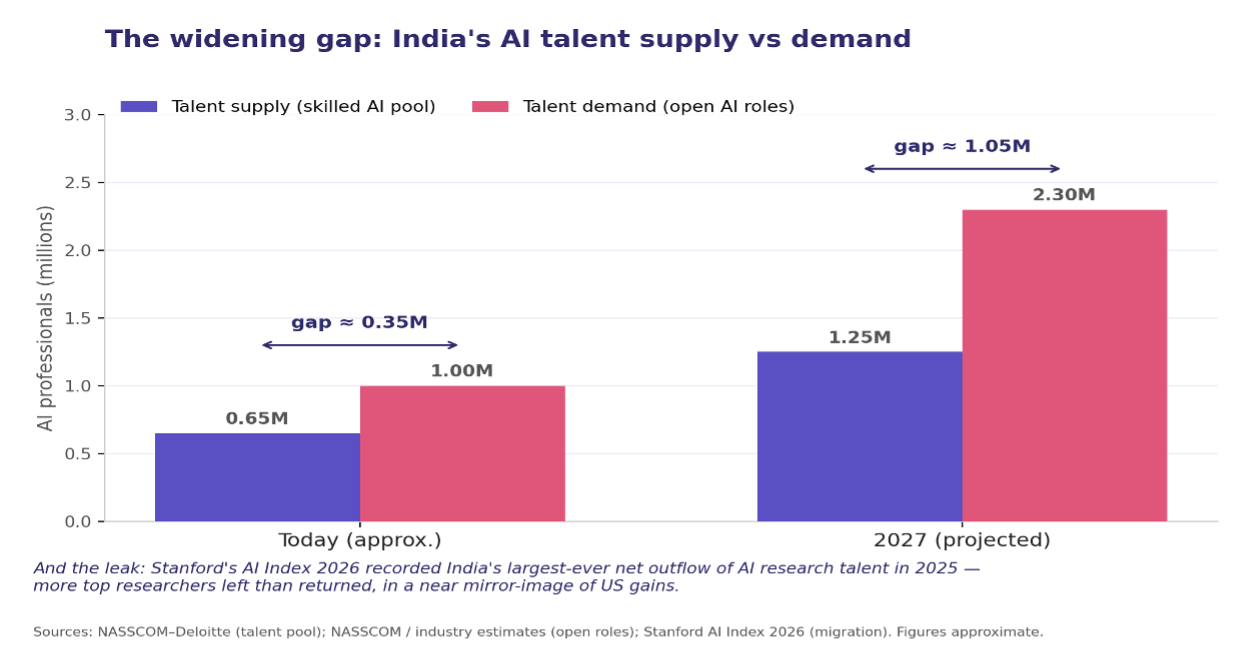
Supply vs demand — and the retention leak underneath it.
What could turn a workforce into a powerhouse
The most powerful retention force already operating is the global capability centre. The Zinnov–NASSCOM landscape for FY2026 counts 2,117 GCCs in India generating USD 98.4 billion in revenue and employing 2.36 million people, making the country the number-one AI hiring market in the world; more than 500 of those centres now run AI-specific mandates, and Fortune-500 GCCs alone hold an estimated 126,600 AI-aligned roles. The decisive shift is qualitative: nearly nine in ten large GCCs now function as innovation hubs rather than cost-arbitrage back offices, owning products and global mandates. That migration up the value chain matters for retention, because it gives ambitious engineers a reason to stay that has nothing to do with relocation. India’s GCCs added more than 150,000 net jobs in 2025 and are expected to add around 200,000 more in 2026.
The second lever is the returnee. With visa friction and research-funding uncertainty unsettling the United States, India sees an opening to reverse the flow. The central government has openly courted Indian-origin AI experts to come home, a push sharpened by the realisation — after low-cost foreign models upended assumptions about how much capital frontier AI requires — that domestic talent may be more decisive than once thought. Tamil Nadu has gone furthest, with a reverse-migration scheme offering globally competitive pay, startup research grants, relocation support and fast-tracked visas, backed by a database of overseas scholars and an annual matching conclave. National research scaffolding is being laid alongside it: high-performance computing clusters, AI-focused research groups at the IITs and IISc, and new generative-AI centres established with industry partners.
The third lever is compute and capital. The IndiaAI compute facility has secured close to 18,700 GPUs, well above its initial 10,000-chip target, and the Mission’s startup-financing pillar feeds an ecosystem in which a striking share of new ventures already build with AI. Yet frontier work needs frontier-scale compute and patient, deep capital, and on both counts India still trails the United States and China by a wide margin. Subsidised GPUs help applied developers; they do not, on their own, create the kind of multi-year, well-funded research environment that keeps a world-class scientist from boarding a flight.
The honest conclusion is that skilling at scale and retention at the frontier are different problems with different solutions. India has largely solved the first and barely begun the second.
A pipeline that produces applied talent by the million does not automatically produce a research ecosystem; that requires sustained funding, laboratories that can pay and equip people at globally competitive levels, and a domestic market willing to buy frontier products. NITI Aayog frames the prize in trillion-dollar terms — AI, on the government’s own estimates, could add around USD 1 trillion to GDP and generate up to five million jobs. Capturing that value, rather than exporting it, is the whole game.
The takeaway
The question was never whether India will have AI talent; it already commands more than almost anyone. The question is whether it captures the value that talent creates or rents it out. A country can be the world’s AI workforce — the place that trains, staffs and operates everyone else’s artificial intelligence — and still not be an AI builder, the place where the defining systems are designed and owned. India today is decisively the first and only aspirationally the second.
The window to change that is open but narrow. The same global turbulence pushing researchers out of the United States could pull some of them home — but only if the labs, the compute, the capital and the compensation are waiting to receive them. Build that, and the supply story becomes a building story, and two and a half million AI professionals start compounding into something the country owns. Fail to, and India keeps doing what it has done for a generation in software: training, superbly and at scale, the people who go on to build the future somewhere else.
By the numbers
2.36M people employed across India’s GCCs — the world’s #1 AI hiring market (Zinnov–NASSCOM, FY2026)
1.25M projected skilled AI talent pool by 2027, up from ~650,000 in 2022 (NASSCOM–Deloitte)
2.3M projected open AI-skilled roles by 2027 — a shortfall above a million people (industry estimates)
53% projected AI talent gap in 2026; ~1 qualified engineer per 10 GenAI openings (TeamLease Digital)
82% of Indian employers unable to fill roles in 2026, vs 72% globally (ManpowerGroup)
2nd / −16.9 India ranks second for AI researchers but posted the world’s largest net outflow in 2025 (Stanford AI Index 2026)
60–100% typical pay jump moving from IT services to a product firm or GCC at 3–4 years
₹10,300 cr (~USD 1.24B) IndiaAI Mission outlay, funding compute, FutureSkills and startups
**