

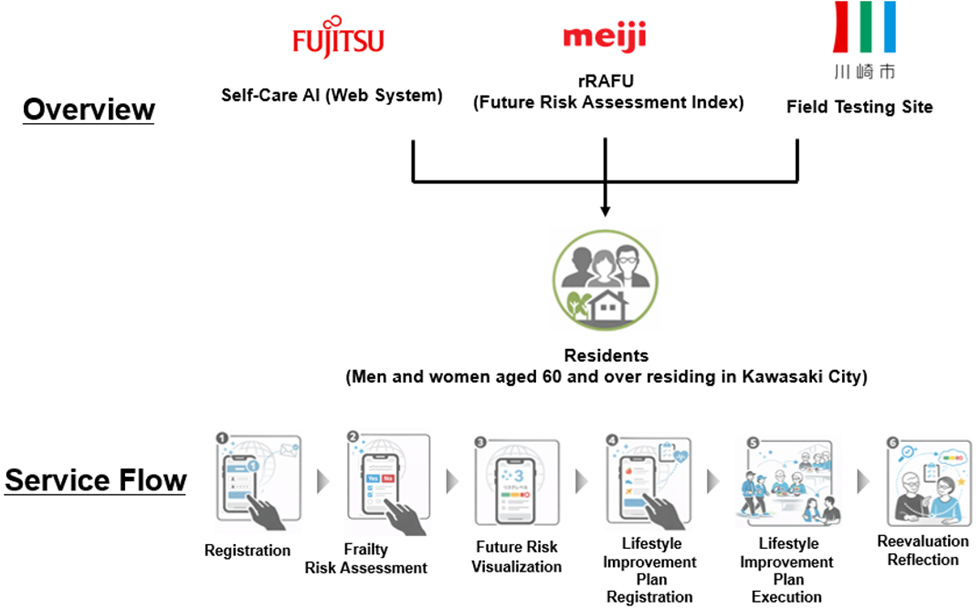
Meiji Co., Ltd. and Fujitsu Limited announced the start of a pilot project towards the social implementation of rRAFU (Rapid Risk Assessment Tool for Future Undernutrition Status), the world's first indicator to predict future risks of malnutrition and frailty (developed by Meiji.) The pilot will focus on residents aged 60 and over in Kawasaki City, Kanagawa Prefecture, Japan.
This pilot project incorporates a self-care support app, built by Meiji and Fujitsu, that combines rRAFU with Fujitsu's AI-driven behavioural change support service. The project will verify the effectiveness of rRAFU and the app's ability to promote behavioural change in frailty prevention among participants in the pilot.
Both companies aim to contribute to frailty prevention among the elderly by enabling early identification of malnutrition and frailty risks, which are often difficult to self-diagnose. Through the self-care support app utilising rRAFU, both companies seek to encourage lifestyle improvements, including diet and exercise, at an early stage before risks become apparent, and will leverage the knowledge gained from this pilot project for future social implementation, aiming to prevent frailty in later life and contribute to people's healthy and secure lives.
Target participants: Approximately 240 people aged 60 and over residing in Kawasaki City.Period: February 2026 to June 2026
In this pilot project, after registering for the self-care support app, participants will undergo a future malnutrition and frailty risk assessment using rRAFU, and the results will be provided to them. Based on the assessment results, participants will select lifestyle improvement plans, such as diet and exercise, that they find manageable. Fujitsu's AI technology will encourage the implementation of these plans via email, tailored to each participant's activity characteristics, thereby supporting their consistent engagement in daily life.
After approximately three months, the project will evaluate the feasibility and sustainability of the actions taken and the resulting changes. Through this pilot project, participants are expected to deepen their understanding of future malnutrition and frailty risks, which were previously difficult to perceive, and to find motivation to initiate and sustain lifestyle improvements.
Meiji provides the rRAFU indicator for assessing future malnutrition and frailty risk and is responsible for planning mechanisms to translate assessment results into lifestyle improvements, as well as the overall project planning. Fujitsu is responsible for the development and operation of the AI-powered app.