
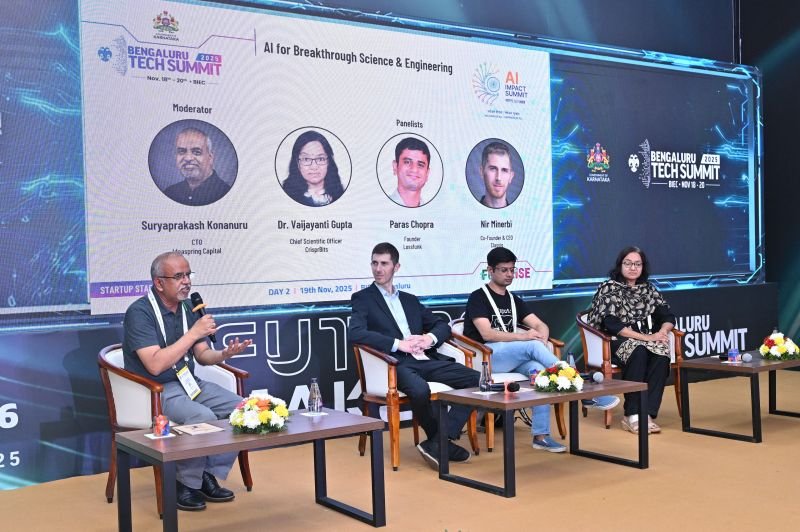
The session titled AI for Breakthrough Science and Engineering at the Bengaluru Tech Summit 2025 brought together innovators, founders and scientific leaders who are pushing the boundaries of what artificial intelligence can achieve in research and deep technology. The discussion explored how AI is accelerating scientific discovery, strengthening engineering workflows and opening entirely new frontiers of innovation.
Moderated by Suryaprakash Konanuru, Chief Technology Officer at Ideaspring Capital, the conversation moved beyond familiar narratives to examine the practical, technical and societal implications of AI powered science.
Setting the Stage The Rise of AI as a Scientific Collaborator
Opening the discussion, Suryaprakash Konanuru emphasised that AI is no longer merely an analytical tool but is emerging as a partner in discovery. He noted that this partnership between human insight and machine intelligence is helping researchers test hypotheses faster, design complex systems with greater precision and explore possibilities that would have taken years to uncover.
Scientific Depth and Real World Complexity
Dr Vaijayanti Gupta, Chief Scientific Officer at Criyagen, shared examples from life sciences where AI is shortening the path from concept to experiment. She explained how data driven modelling is enabling researchers to understand biological systems at unprecedented scale and speed. Dr Gupta stressed that AI must be integrated with domain expertise because science remains deeply contextual and often unpredictable. She highlighted the need for robust datasets, meaningful validation methods and interdisciplinary collaboration to ensure that AI led insights translate into real world outcomes.
Engineering Breakthroughs through Intelligent Automation
From an engineering and product perspective, Paras Chopra, Founder of VWO and Leadsquared, explored how AI is enabling ambitious design goals. He pointed out that automation and simulation driven innovation are helping engineers identify optimal solutions with less trial and error. He noted that AI is transforming product development workflows by enabling rapid prototyping, predictive analysis and smart experimentation. According to him, the real promise of AI lies in making engineering more creative and less constrained by manual bottlenecks.
Quantum Perspectives and the Next Frontier
Adding a global deep tech viewpoint, Nir Minerbi, Co Founder and Chief Executive Officer of Classiq, discussed how AI is supporting the advancement of quantum computing. He observed that quantum systems are highly complex and cannot be modelled through traditional methods alone. AI is helping researchers manage this complexity, design quantum circuits more efficiently and accelerate overall progress in the field. He noted that the intersection of quantum and AI will define the next era of scientific and technological breakthroughs.
Key Insights Shaping the Future of AI in Science and Engineering
Across the session, the speakers converged on a few shared conclusions:
-
Scientific and engineering advancement requires close collaboration between AI systems and human expertise
-
Data quality, validation frameworks and ethical safeguards are essential
-
AI can significantly reduce research timelines and improve precision
-
Breakthroughs will come from interdisciplinary work and open innovation
-
India and global partners have a unique opportunity to co shape the next evolution of deep technology
A Future Driven by Intelligent Discovery
The session made clear that AI is redefining the boundaries of what science and engineering can achieve. Whether in biology, software, manufacturing or quantum systems, AI is enabling a new era of accelerated discovery. As human creativity aligns with machine scale computing, the path to innovation becomes more accessible, more inclusive and more ambitious.
The panel left the audience with a compelling message: the future of scientific progress belongs to those who are willing to combine curiosity with computation, and imagination with intelligence.